

Walk into any overcrowded home and you'll feel it immediately: a low-level visual noise that makes it hard to relax. Now walk into a room where every piece has been chosen with purpose, and the difference is remarkable. Curated home décor involves intentional selection of fewer, higher-quality pieces that enhance personal expression and create cohesive, stylish living spaces. For UK homeowners, this approach isn't just aesthetically pleasing. It's a practical, financially savvy way to transform your home without endlessly buying more.
Table of Contents
- What sets curated home décor apart
- Practical and financial benefits of curated décor
- Curated décor vs mass-market: authenticity, sustainability, and trends
- Possible pitfalls and how to avoid them
- Our take: the art of balance in curated home décor
- Explore quality curated décor solutions for your home
- Frequently asked questions
Key Takeaways
| Point | Details |
|---|---|
| Intentional selection | Curated home décor is about picking fewer, high-quality items that reflect your personality and create cohesive spaces. |
| Boosts property value | Thoughtful décor choices can increase your home’s market value and appeal to buyers in the UK. |
| Sustainable and authentic | Curated décor supports artisans, reduces waste, and helps build genuinely lived-in homes. |
| Balance, not excess | Avoid over-curation by combining style, practicality, and comfort for a naturally appealing space. |
What sets curated home décor apart
Most people assume decorating a home simply means filling it with things they like. The result is often a room that feels busy, inconsistent, and somehow still unsatisfying. Curated home décor works differently. It starts with intention rather than impulse.
Curated home décor is built on the principle of quality over quantity. You're selecting pieces that speak to one another, that share a colour palette, a material language, or a consistent mood. The outcome is a home that feels genuinely considered rather than assembled by accident.
Here's what separates curated from cluttered:
- Intentional selection: Every piece earns its place in the room
- Cohesive visual story: Colours, textures, and styles work in harmony
- Quality materials: Investment pieces that age well rather than fast-furniture replacements
- Personal expression: Reflects who actually lives there, not just what's on trend
- Functional beauty: Items that look good and serve a purpose
"The most beautiful homes aren't the most expensive. They're the ones where you can sense a person's genuine taste and life story in every corner."
The shift from mass-market decorating to a curated approach also changes how you shop. Rather than buying a room set from a big catalogue retailer, you start selecting home accessories with real thought. You ask: does this earn its place? Does it add something no other piece already does? This slower, more deliberate approach tends to save money over time and produces far more satisfying results.

It's also worth noting that curated décor isn't minimalism. You don't have to strip everything back to bare walls and one plant. You can have layered, warm, even eclectic spaces. The key is that each element is there because you actively chose it, not because it ended up there by default. Looking at 2026 décor trends, this intentional layering is very much at the forefront of how UK homeowners are choosing to live.
Pro Tip: Begin with a single focal piece you absolutely love, perhaps a statement lamp, an artwork, or a textured throw, and build the rest of the room's palette and mood around it. This gives you a clear reference point and prevents the common mistake of buying items that look great alone but clash together.
Practical and financial benefits of curated décor
Understanding why curated décor looks better is one thing. Understanding why it's genuinely worth the investment is another, and for UK homeowners, the financial case is compelling.
Custom and curated finishes boost property value by 3 to 5%, with 68% of buyers willing to pay extra for quality and personalisation, and return on investment sits at 60 to 75% for kitchen and bathroom upgrades. These aren't abstract figures. They represent real money when it comes time to sell or remortgage.
| Area of home | Approximate ROI from curated upgrades | Buyer appeal rating |
|---|---|---|
| Kitchen | 60 to 75% | Very high |
| Bathroom | 60 to 70% | High |
| Living room | 45 to 55% | High |
| Bedroom | 35 to 50% | Moderate |
| Hallway/entrance | 30 to 45% | Moderate to high |
Beyond resale value, curated décor offers practical day-to-day advantages that genuinely improve how you feel in your home:
- Easier to clean and maintain: Fewer items means less dusting, tidying, and organising
- Mental clarity: Visual order has a measurable impact on stress levels
- Better use of space: Chosen pieces often serve multiple functions
- Reduced buying impulse: Once a space feels complete, you're less tempted to keep adding
- Longer-lasting appeal: Quality pieces don't date as quickly as trend-driven fast furniture
For homeowners thinking about upgrading for value, starting in the kitchen or bathroom is almost always the most financially intelligent move. A few well-selected accessories and finishes in these rooms consistently deliver the strongest return.
It's also worth reflecting on what the true purpose of décor actually is in a functioning home. Décor isn't purely visual. It shapes how you move through a space, how you feel when you wake up, and whether your home feels like a genuine refuge or just a place you sleep. Curated choices support that deeper function in a way that impulse purchases simply cannot.
Statistic spotlight: 68% of UK buyers will pay more for a home with quality, personalised finishes. That's not a small margin. It's a majority.
Curated décor vs mass-market: authenticity, sustainability, and trends
Mass-market home furnishing has become extraordinarily convenient. You can furnish an entire flat in a single online session and have everything delivered within days. But speed and convenience come with real costs, and UK homeowners are increasingly waking up to them.
UK homewares retailing research shows a clear trend towards second-hand, pre-loved, and artisan goods, driven by both environmental concern and a desire for authenticity that mass-market items simply cannot provide.
| Feature | Curated décor | Mass-market décor |
|---|---|---|
| Authenticity | High: unique, personal pieces | Low: identical across thousands of homes |
| Sustainability | Strong: artisan support, pre-loved encouraged | Weak: fast furniture cycle, high waste |
| Longevity | Long: quality materials and timeless design | Short: trend-driven, replaced frequently |
| Environmental impact | Lower: fewer purchases, ethical sourcing | Higher: volume production, packaging waste |
| Cost over time | Lower: buy less, replace less | Higher: frequent replacement adds up |
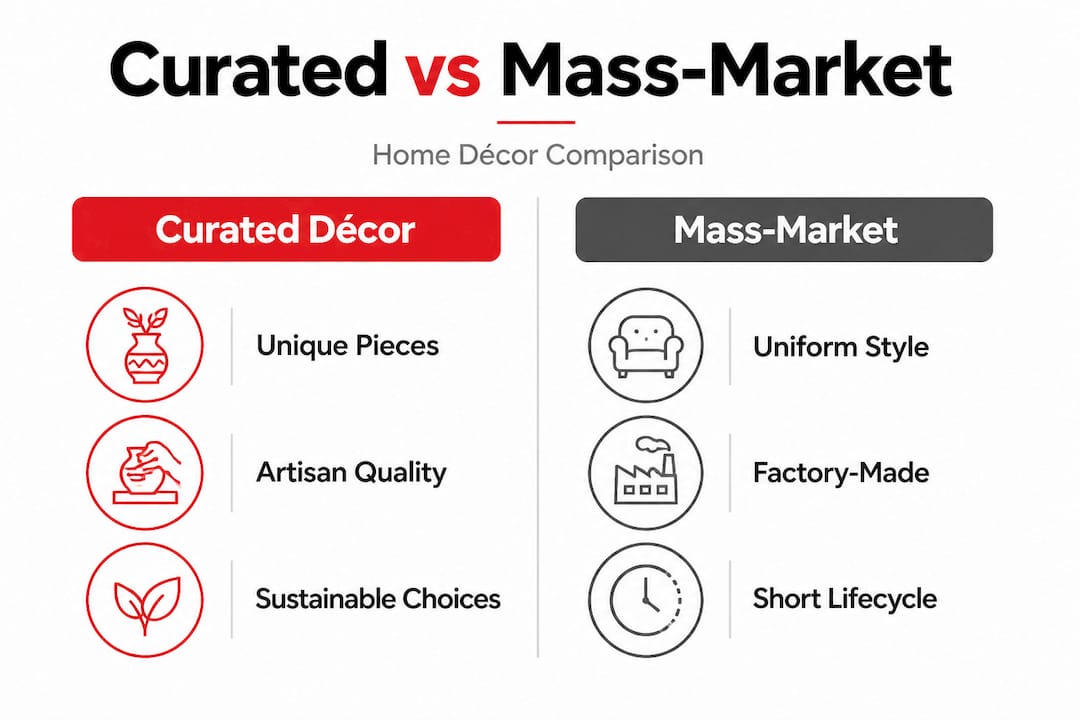
The sustainability argument is particularly strong in the UK context. Fast furniture produces an enormous volume of waste. Millions of sofas, flatpack shelving units, and decorative items end up in landfill each year, often after just two or three years of use. Curated décor, by contrast, encourages buying fewer pieces that last longer, supporting independent makers where possible, and embracing pre-loved items that already have a life story.
There's also a genuine authenticity issue. When the same mass-produced items appear in thousands of homes across the country, a space can look styled without ever feeling personal. Curated décor, whether drawn from artisan makers, vintage markets, or practical ideas for UK spaces, creates rooms that actually reflect the people who live in them.
For homeowners interested in functional décor choices, this approach also tends to favour pieces that genuinely work within daily routines rather than looking impressive in photographs but offering nothing practical. A beautifully made ceramic storage jar, a hand-thrown vase, a well-designed wall hook: these are examples of items that look considered and serve a real purpose.
If you're interested in making your own mark on your space, a DIY décor guide is an excellent starting point for UK homeowners who want personalised results without the premium price tag of buying everything ready-made.
Possible pitfalls and how to avoid them
Curated home décor is a genuinely powerful approach, but it's possible to take it too far. The pitfalls are worth understanding before you commit to a complete overhaul.
-
Over-curation creates a sterile environment. When a room looks so perfect it feels like a hotel lobby rather than a home, something has gone wrong. Real homes have lived-in textures: the book left face-down, the child's drawing on the fridge, the worn patch on the favourite chair.
-
Chasing aesthetics removes personal meaning. If you're decorating to impress an imaginary audience rather than to please yourself and your household, the space will always feel slightly off. Style without substance reads hollow.
-
Hyper-personalisation can reduce resale appeal. Over-personalisation risks dating quickly or reducing resale appeal if your choices are very specific to your own taste rather than broadly appealing. There's a balance to strike, especially if you're planning to sell within a few years.
-
Trend-led curation has a short shelf life. Choosing pieces because they're currently popular on social media rather than because you genuinely love them means you'll likely feel the urge to redecorate within 18 months.
-
Ignoring comfort in favour of appearance. A beautiful room that's uncomfortable to sit in, cold, or impractical for how your household actually lives has failed at its core job.
"The goal of curation isn't perfection. It's a space that feels deeply yours, where comfort and beauty are treated as equally important."
Creating a cosy hygge-inspired space is a strong counterpoint to over-curation. The hygge philosophy, drawn from Scandinavian living, actively prioritises warmth, softness, and the comfort of imperfection. It's a useful corrective for anyone who finds themselves leaning towards spaces that look flawless but feel cold.
The relationship between décor and wellbeing is well-established: our surroundings have a direct influence on mood, sleep, and even productivity. The best-curated spaces honour this by choosing pieces that create genuine comfort, not just visual polish. If you're working towards stylish décor for comfort, keep asking yourself whether each choice serves the people living in the space, not just the Instagram grid.
Pro Tip: Use personal stories as your compass. A piece of pottery you bought at a local market, a print that makes you laugh every morning, a throw your grandmother made. These items ground a space in authenticity and resist being replaced the moment trends shift.
Our take: the art of balance in curated home décor
Here's an honest view that most interior inspiration accounts won't share: the most common mistake UK homeowners make isn't buying too little. It's buying with the wrong motivation.
Curated home décor works brilliantly when it starts from a genuine place, your actual life, your real preferences, the things that make you feel at home. It starts to fail when it becomes a performance: a carefully assembled backdrop for living rather than a space you live in.
We've seen this play out repeatedly. Someone spends months building what looks like a beautifully curated room, only to feel vaguely dissatisfied because nothing in it connects to how they actually spend their days. The opposite is equally true: a home full of genuinely meaningful objects, comfortable furniture, and practical choices can look incredibly stylish without ever having been consciously "curated" at all.
The contrarian truth is that authenticity is the most powerful design tool available to any homeowner. Not trends, not a strictly limited colour palette, not the most expensive artisan pieces you can afford. Authenticity. The willingness to put something in your home because you love it, even if it doesn't quite match the rest of the room.
This is why we believe understanding the true purpose of décor is so important before spending a penny on any upgrade. When you're clear on what a space needs to do for you, the right choices become far more obvious and far less expensive.
For UK homeowners in particular, there's a strong cultural inclination towards practical value. A beautiful piece that also stores something, provides light, adds warmth, or creates a focal point for conversation: that's curated décor at its best. Not art for art's sake. Not minimalism for its own sake. Just thoughtful choices, made by real people, for real homes.
Explore quality curated décor solutions for your home
Finding pieces that genuinely earn their place in your home takes time, and knowing where to look makes all the difference.
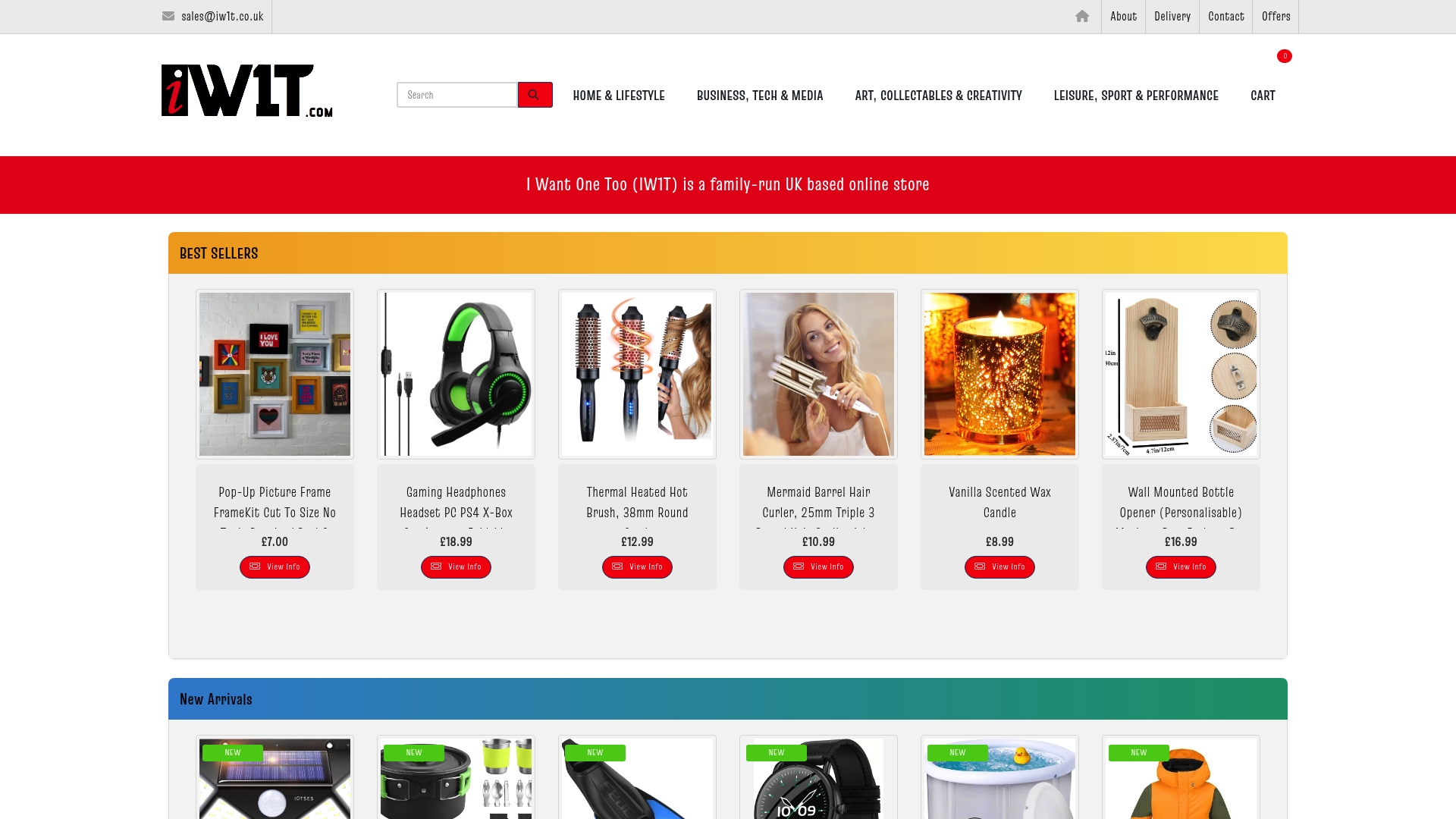
At IW1T, we've built our home décor range around exactly this principle: practical, stylish, and thoughtfully selected. As a UK-based family business, we understand what British homeowners actually need from their spaces, and we've brought together items that deliver on both aesthetics and everyday function. Whether you're refreshing a single room or approaching a broader overhaul, explore the curated décor range at IW1T for pieces that are chosen with the same care and intentionality this article has described. Quality you can feel, style that lasts, and delivery you can trust.
Frequently asked questions
How does curated home décor affect property value in the UK?
Curated finishes boost property value by 3 to 5%, and 68% of buyers are willing to pay extra for quality and personalisation, particularly in kitchens and bathrooms where ROI reaches 60 to 75%.
What are the risks of over-curating a home?
Hyper-curation can appear performative and disconnected from real living, while over-personalisation risks reducing your home's resale appeal or making it feel more like a showroom than a genuine sanctuary.
How is curated décor more sustainable than mass-market alternatives?
Curated décor supports artisans, reduces fast furniture waste, and aligns with the growing UK trend towards second-hand and pre-loved items, making it a notably friendlier choice for the environment.
Can curated home décor be both stylish and practical?
Absolutely. Curated home décor is specifically designed to blend style with function, selecting pieces that enhance personal expression, create cohesive spaces, and support comfortable, practical day-to-day living.