
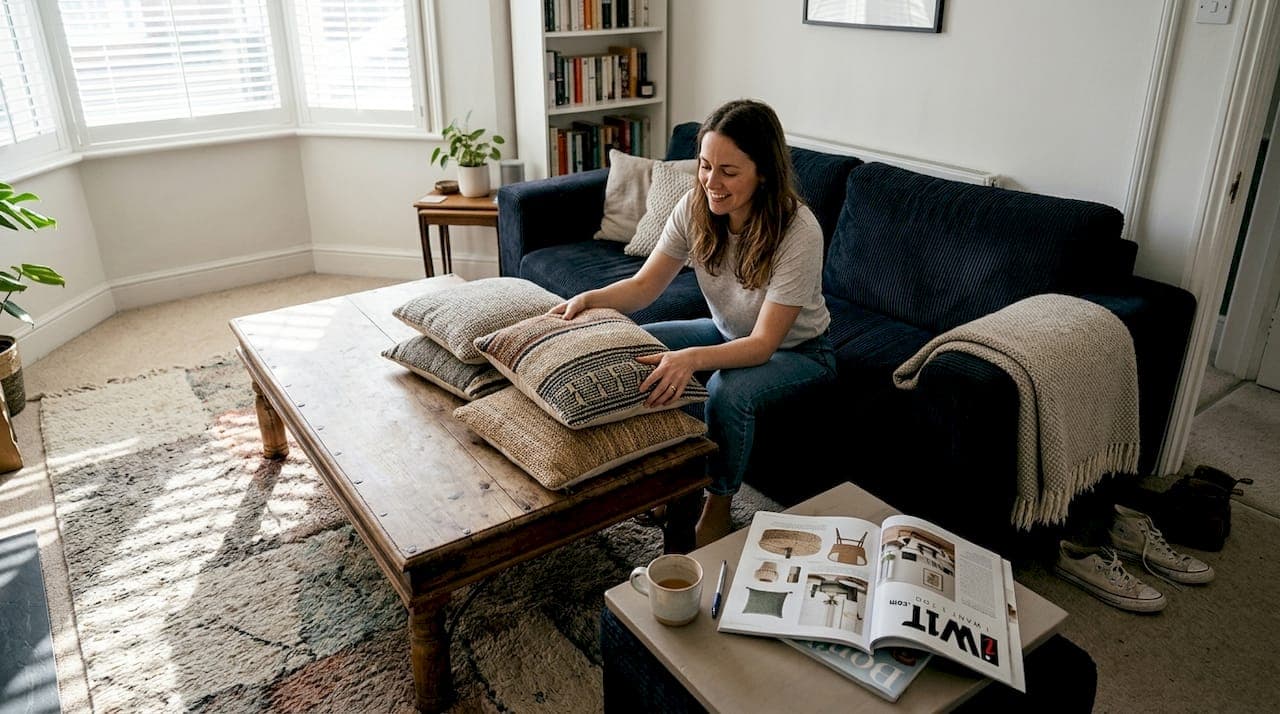
You spot a beautiful throw pillow online, then a sleek lamp, then a set of ceramic vases, and before you know it, your basket is full but your room still feels off. Choosing home accessories that actually work together, and for your lifestyle, is harder than it looks. The gap between a room that feels pulled-together and one that feels cluttered often comes down to a few deliberate decisions. This guide walks you through a clear, step-by-step process for selecting accessories that genuinely improve your home's comfort, function, and personality.
Table of Contents
- Assess your needs and style preferences
- Gather inspiration from reliable sources
- Choose accessories that balance function, style, and sustainability
- Place and layer your accessories for maximum impact
- A fresh perspective on home accessories: why less is more
- Find the perfect accessories for your home at IW1T
- Frequently asked questions
Key Takeaways
| Point | Details |
|---|---|
| Start with essentials | Focus on foundational pieces like quality rugs and lighting before adding decorative accents. |
| Balance style and function | Choose accessories that both enhance comfort and express your personality. |
| Be sustainable | Consider eco-friendly materials and ethical brands to create a home that's stylish and responsible. |
| Edit your space | Curate thoughtfully to avoid clutter and highlight your favourite accessories. |
Assess your needs and style preferences
Before you buy a single thing, take a proper look at how you actually live. This is not about aesthetics first. It is about understanding what your home genuinely needs and where your daily routines create friction or joy.
Start by walking through each room with fresh eyes. Ask yourself honest questions:
- What feels missing or incomplete in this space?
- Which rooms do you use most throughout the day?
- Are you prioritising comfort, practicality, or visual interest?
- What materials or colours do you naturally gravitate towards?
- Is there anything that currently frustrates you about how a space functions?
- Do you entertain often, or is your home mostly a private retreat?
These answers shape every purchase decision that follows. Someone who works from home needs a very different set of priorities from someone who uses their flat mainly for winding down in the evenings.
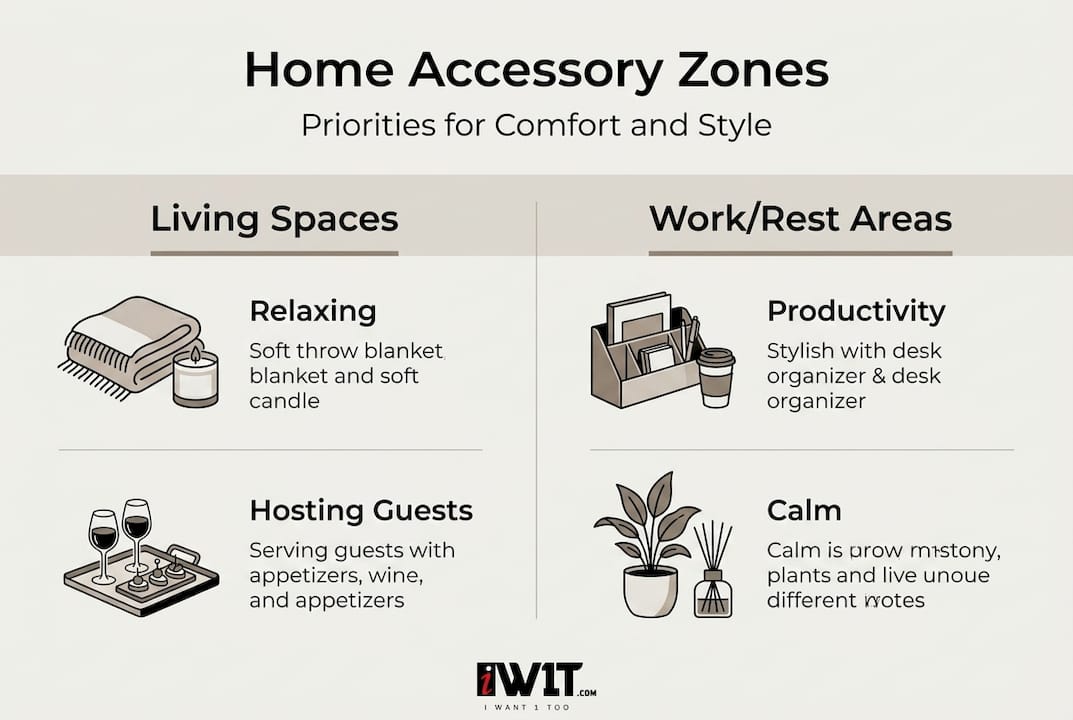
It also helps to separate your home into zones. A living room used for both relaxing and hosting guests has different accessory needs than a bedroom that is purely for rest. Once you have a clearer map of how each area functions, you can assign purpose to your choices rather than shopping on impulse.
Style preferences matter enormously too, but they are easier to define than most people think. You do not need to pick a label like "Scandi" or "maximalist." Instead, as experts in home accessory selection suggest, invest in quality rugs, lighting, and mirrors as timeless anchors, then layer in sustainable natural fibres like wool and linen, mixing ethically sourced pieces with second-hand finds for genuine character.
Pro Tip: Start with the materials and colours already present in your space. Pull one or two of those tones into your accessories to create cohesion without having to redesign the whole room.
If you are not sure where to begin with product selection, browsing top UK home accessories can help you see how different styles and functions translate into real products.
Gather inspiration from reliable sources
Once you have identified your priorities and baseline style, it is time to gather inspiration that matches your vision rather than one that overwhelms it.
The most useful starting point is narrowing your sources. Trying to absorb every interior trend from dozens of accounts leads to confusion, not clarity. Pick two or three sources that consistently reflect a look you love and stick with them during your planning phase.
Useful inspiration sources include:
- Instagram and Pinterest: Search by room type and colour palette rather than generic terms like "home decor"
- UK interior magazines: Livingetc, Homes & Gardens, and House Beautiful cover realistic British home styles
- Showrooms and high street shops: Seeing items in person gives you a much better sense of scale and texture
- Lifestyle blogs: Look for writers based in the UK who reflect similar living situations
When comparing retailers, it helps to understand the trade-offs between different shops. Here is a quick overview of how some well-known contemporary UK accessory shops and retailers position themselves:
| Retailer | Style focus | Price range | Key strength |
|---|---|---|---|
| John Lewis | Classic, quality | Mid to high | Reliability and range |
| Dunelm | Practical, everyday | Budget to mid | Value and variety |
| Habitat | Modern, design-led | Mid | Distinctive aesthetic |
| The White Company | Neutral, refined | Mid to high | Texture and comfort |
| Toast | Slow fashion, ethical | High | Sustainability and craft |
As noted by home styling guides covering UK retail options, shops like John Lewis, Habitat, Dunelm, The White Company, and Toast each offer something distinct, from practical everyday finds to ethically minded, beautifully crafted pieces.
The key is matching your source of inspiration to your actual budget and lifestyle. There is no point falling in love with a £300 handmade ceramic lamp if your priority is redecorating an entire room on a modest budget. Use aspirational sources to identify a direction, not necessarily the exact product.
Choose accessories that balance function, style, and sustainability
With plenty of inspiration gathered, you can now focus on picking individual accessories with real purpose and sustainability in mind. This is where most people either get it right or lose their way entirely.
Start by comparing materials, because the material of an accessory affects how it looks, feels, and lasts:
| Material | Feel and look | Durability | Sustainability notes |
|---|---|---|---|
| Linen | Light, natural texture | High | Biodegradable, low impact |
| Wool | Warm, textured, rich | Very high | Renewable if ethically sourced |
| Cotton (organic) | Soft, versatile | Medium | Better than conventional cotton |
| Recycled glass | Sleek, modern | High | Excellent eco credentials |
| Solid wood | Classic, sturdy | Very high | Sustainable if FSC-certified |
Once you know what materials suit your needs, follow this process for each category of accessory:
- Identify the function first: Does this item solve a problem or improve daily comfort?
- Set a firm budget per category: Allocate more to anchor pieces, less to trend items
- Check the source: Prioritise ethical brands, British makers, or second-hand where possible
- Assess scale: Hold the item against a wall or compare dimensions to your space before buying
- Test with what you own: If shopping in person, imagine the item alongside your existing furniture
- Buy one at a time: Resist the urge to overstock; live with a piece before adding more
As interior styling guidance on upcycling and sourcing makes clear, sourcing second-hand or upcycled items adds genuine uniqueness to your home while keeping large, trend-heavy pieces out of landfill.

Pro Tip: Spend the majority of your accessory budget on rugs, mirrors, and lighting. These anchors set the tone for a room. Add trend-led items like cushion covers or small vases in smaller, more affordable touches that are easy to swap out as your taste evolves.
Place and layer your accessories for maximum impact
After selecting your accessories, the final step is placing and arranging them for the best possible effect. Even beautiful objects can look wrong if they are poorly positioned or grouped without thought.
Follow these basic principles for arranging:
- Use odd numbers: Groups of three or five objects create natural visual interest
- Vary the height: Mix tall items with low ones to lead the eye across a surface
- Layer from back to front: Place larger or taller pieces at the back, smaller ones forward
- Create breathing space: Leave at least a third of any surface clear
- Anchor with a base: Use a tray or a book to ground a grouping and prevent it looking scattered
- Repeat colours or shapes: Carry one element across the room to tie the look together
The best-accessorised homes are not the fullest ones. They are the ones where every item has been chosen intentionally and given room to be noticed. Quality anchors like rugs, lighting, and mirrors, as interior experts recommend for impact, do the heavy lifting, while sustainable natural fibres and upcycled pieces add texture and story.
Common mistakes to avoid when arranging accessories:
- Over-accessorising: Too many items on one surface cancel each other out visually
- Ignoring scale: A tiny ornament on a large shelf looks lost; a huge vase in a compact alcove feels oppressive
- Colour clashes: Mixing too many competing tones without a unifying shade creates visual noise
- Matching everything too precisely: Perfectly matching sets tend to look sterile rather than styled
- Forgetting function: Decorative items should not make practical tasks harder
A fresh perspective on home accessories: why less is more
There is a widespread assumption that a well-accessorised home is a fully accessorised one. Walk into any high street homeware shop and the display tables are piled high, every surface busy. It creates a feeling of abundance, but it is also a retail strategy, not an interior design one.
In our experience, the homes that feel most genuinely comfortable and personal are almost always the edited ones. Not minimalist for the sake of it, but curated. Every cushion earns its place. Every candle holder means something. The impulse to fill empty space is understandable, but that space is actually doing a job. It is giving your eye somewhere to rest.
The uncomfortable truth is that most people buy too much, too quickly. A room does not need ten accessories to feel finished. It usually needs three good ones, placed well. Editing is not a failure of ambition. It is a sign that you know exactly what you want your home to feel like, and you are not willing to settle for a cluttered imitation of it.
Find the perfect accessories for your home at IW1T
Ready to refresh your space with accessories that genuinely earn their place?
At IW1T, a family-run UK business established in 2022, we have hand-picked a range of home accessories with exactly these principles in mind. Every piece in our collection is chosen for its practical value, quality, and ability to enhance daily living. Whether you are looking for something to anchor a room, add texture, or simply bring a little more comfort to your everyday surroundings, our curated selection covers home décor, wellness, and lifestyle products delivered with discretion and care. Browse IW1T's home accessories and find pieces that truly complete your space.
Frequently asked questions
What are the most important accessories to invest in for my home?
Focus your budget on quality rugs, statement lighting, and versatile mirrors as key room anchors, then layer in smaller, trend-led pieces around them.
How do I mix new accessories with what I already own?
Start with a neutral or cohesive colour palette and introduce new items that share a similar material, scale, or tone with what you already have, blending old and new naturally.
Which UK shops offer sustainable home accessories?
Shops such as Toast, John Lewis, and The White Company are consistently noted for sustainable and ethical home accessory options suited to a range of budgets.
How can I avoid clutter when accessorising my flat or house?
Limit each surface to a few meaningful or functional pieces and keep at least a third of the area clear, allowing the room to breathe and the items you have chosen to stand out.