
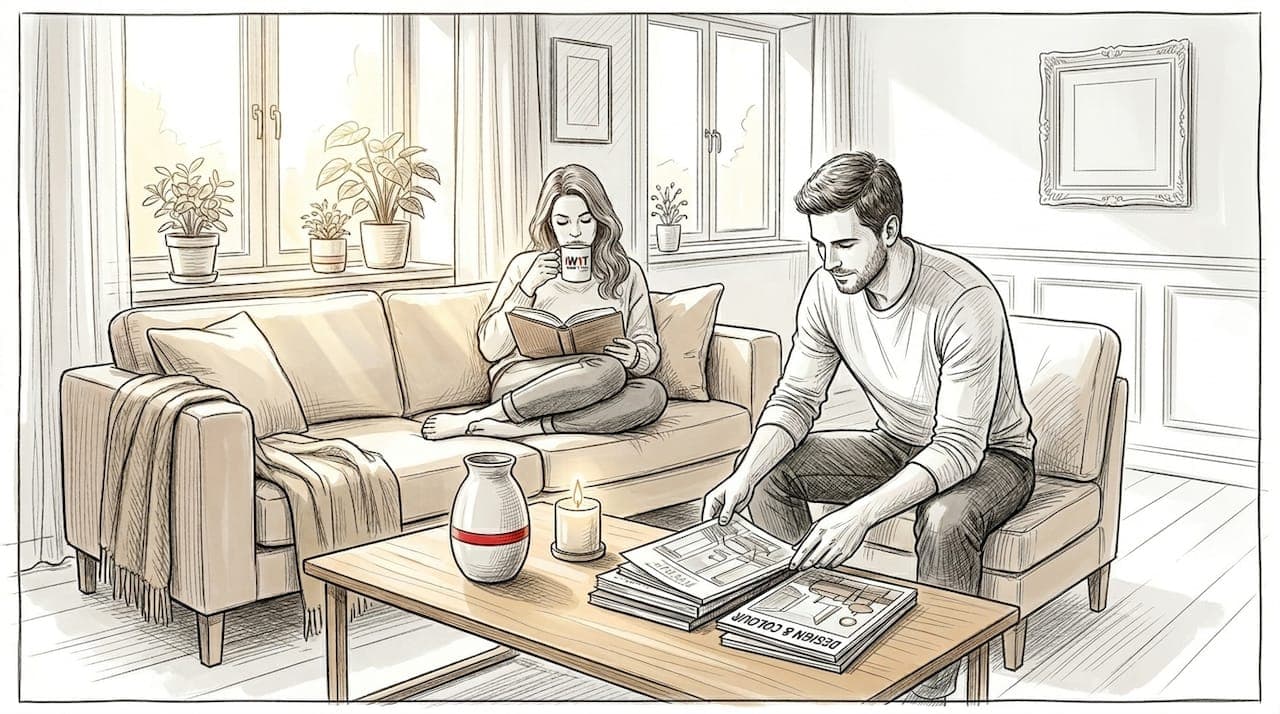
Aesthetic home décor is one of those phrases that gets misused constantly. Most people assume it means white walls, one plant, and very little else. In reality, what is aesthetic home décor has nothing to do with emptiness and everything to do with intention. A well-styled aesthetic home can be warm, layered, and full of personality. It just feels deliberate rather than accidental. Whether you own your home or rent a flat in Bristol or Birmingham, this guide will show you exactly what aesthetic décor involves and how to apply it without starting from scratch.
Table of Contents
- Understanding what aesthetic home décor really means
- Why negative space matters in creating an aesthetic home
- Layering and cohesion: the secrets to avoiding a flat, cluttered look
- How to craft your personal aesthetic direction for a cohesive home
- Practical steps to apply aesthetic home décor in your own space
- Why editing and spatial relationships matter more than quantity in aesthetic décor
- Explore stylish, practical home décor at I Want 1 Too
- Frequently asked questions
Understanding what aesthetic home décor really means
The word "aesthetic" comes from the Greek word for perception and feeling. In home décor, it simply means that your space creates a consistent, intentional impression. It is not a style in itself. It is a quality that any style can have. Scandi, maximalist, cottagecore, industrial — any of these can be aesthetic or not, depending on how thoughtfully they are executed.
Aesthetic home décor relies on three foundations: cohesion, layering, and what designers call negative space (the intentional areas of visual rest in a room). It is not about having less. It is about making sure everything present earns its place. Understanding the true purpose of décor helps clarify this distinction immediately.
Here is what separates aesthetic décor from simply collecting things you like:
- Cohesion: Pieces feel connected through colour, material, or tone
- Editing: Nothing is kept by default. Each item is chosen deliberately
- Negative space: Negative space is a core design principle for achieving a look that feels calm and composed
- Layering: Depth is created through texture, light, and varying heights
- Personal expression: The space reflects your taste, not a showroom formula
Understanding what makes a room aesthetic comes down to intentionality. Browse popular home décor styles and you will notice the most beautiful rooms all share this quality, regardless of their individual flavour.
Why negative space matters in creating an aesthetic home
Negative space is not emptiness. That distinction matters. An empty room is just unfinished. A room with negative space is one where the arrangement of objects has been considered in relation to the surrounding open area. Think of it like typography: the space between letters is what makes words legible. Take it away and everything becomes noise.
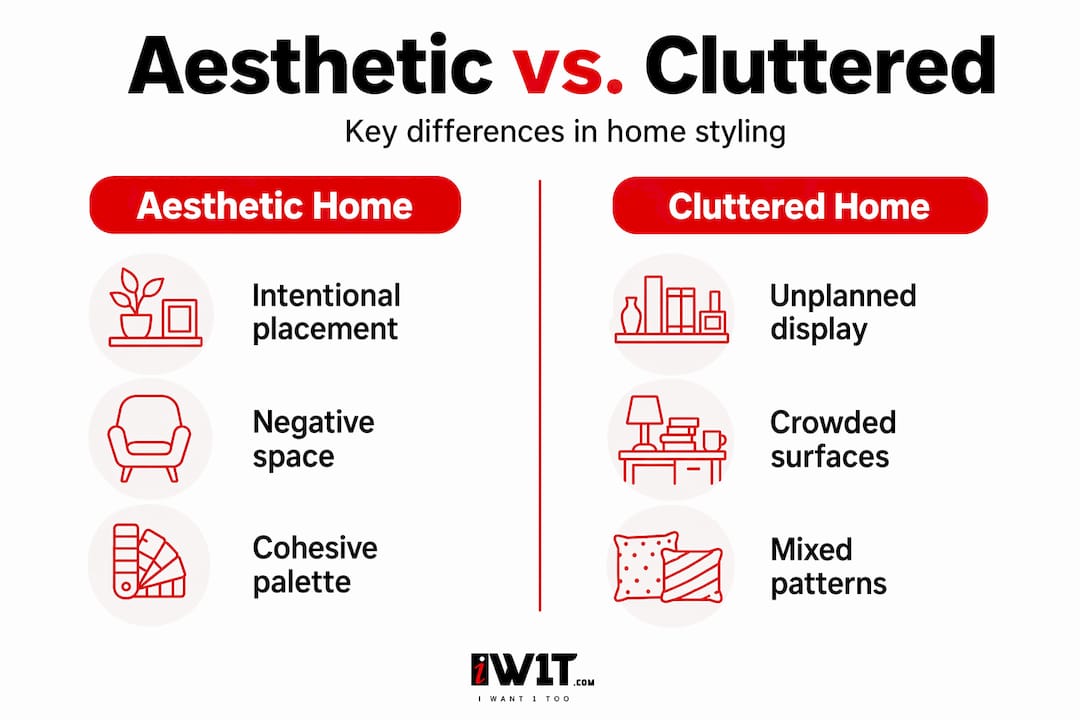
Negative space guides the eye and creates breathing room, preventing visual fatigue while enhancing the sense of calm in a room. This is why two rooms with identical furniture can feel completely different. One has been arranged with spatial awareness; the other has simply been filled.
The wellbeing connection here is real and measurable. Research shows that home clutter negatively correlates with psychological well-being and life satisfaction, mediated by how beautiful a home feels. In other words, a perceived sense of beauty in your space actively buffers the mental toll of disorganisation. This is exactly why home décor and wellbeing are so closely linked.
Pro Tip: When arranging a shelf or surface, place your items first, then actively remove one or two. What remains immediately looks more curated and intentional.
Practical ways to use negative space in your home:
- Leave visible wall area between frames rather than filling every inch
- Allow furniture legs to show rather than tucking pieces tightly together
- Keep at least one clear surface per room, even if everything around it is layered
- Resist filling corners with furniture unless it genuinely improves the flow
- Create deliberate pauses between grouped objects on shelving
Layering and cohesion: the secrets to avoiding a flat, cluttered look
A common fear with aesthetic décor is that editing will make a room feel sparse or cold. This is where layering comes in. Layering is the practice of building visual depth through texture, lighting, and materials, so that a room feels rich even when it is not overcrowded.
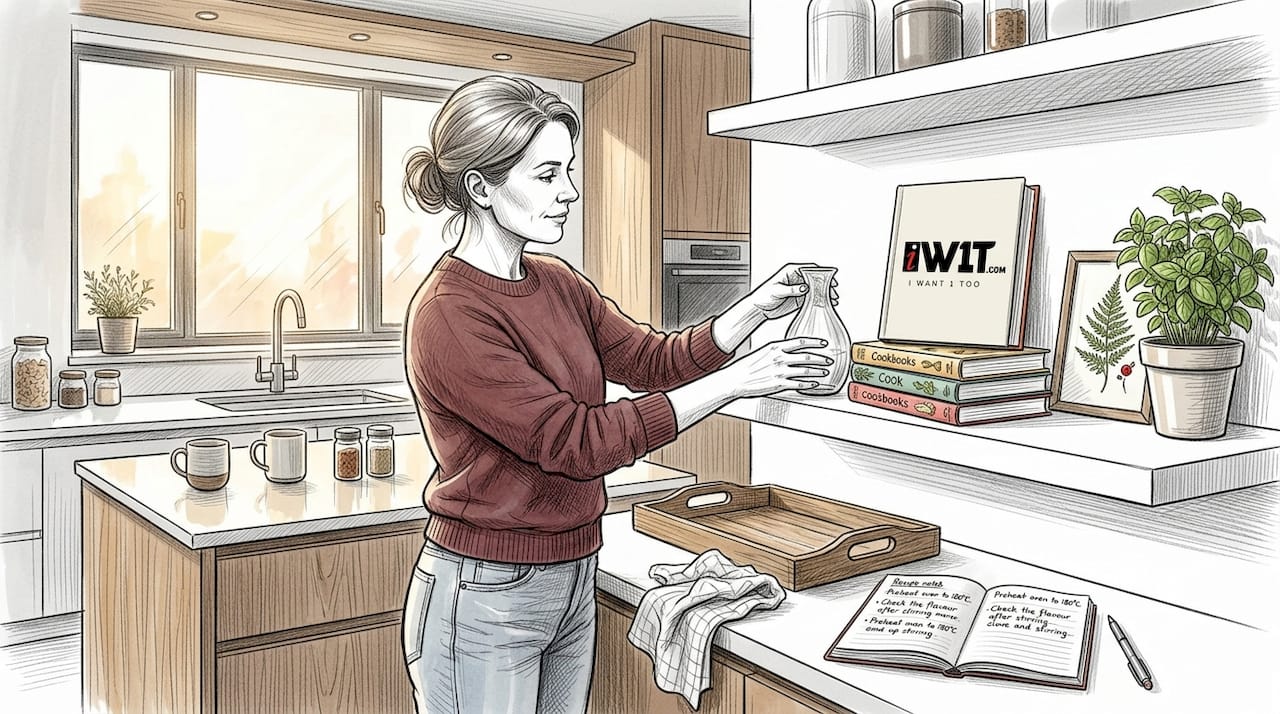
Layering lighting and texture adds mood and richer visual interest, lifting the aesthetic from flat to dynamic. Practically, this means using multiple light sources at different heights rather than relying on a single ceiling light. A floor lamp in the corner, a table lamp on a side table, and candles on a surface create a completely different atmosphere than overhead lighting alone. The room suddenly has layers.
Follow these steps to layer effectively without creating chaos:
- Establish your base: Choose a dominant texture or material (linen, oak, concrete) and let it anchor the room
- Add a secondary layer: Introduce a complementary texture such as wool, rattan, or velvet to create contrast
- Apply the 60-30-10 rule: 60% of the room reflects your dominant colour, 30% a secondary shade, and 10% an accent that expresses personality
- Layer your lighting: Combine ambient, task, and accent lighting at different heights
- Edit as you layer: Adding texture does not mean adding more objects. A chunky knit throw adds more visual interest than three decorative trinkets
Knowing how to select home accessories thoughtfully is what separates a layered room from a busy one. You want contrast without competition. If you would like to explore how this works across different spaces, take a look at ideas for stylish décor for comfort.
Pro Tip: If a room feels flat despite your efforts, try varying the height of your objects on surfaces. Group a tall vase with a mid-height candle holder and a low bowl. The difference in elevation alone creates instant visual movement.
How to craft your personal aesthetic direction for a cohesive home
Most people do not have an incoherent home because they lack taste. They have one because they have never defined their aesthetic direction. Without a framework, every purchase is a one-off decision. With one, every purchase either fits or it does not.
A consistent aesthetic direction acts as a framework for intentional style, preventing chaotic décor. Think of your aesthetic direction as three to five words that describe how you want your home to feel: "warm, natural, quiet" or "bold, graphic, layered." These become your filter.
Here is how to identify and apply yours:
- Gather your references: Save images you genuinely love, not ones you think you should love. Patterns will emerge quickly
- Identify your repeating themes: Note recurring colours, materials, moods, and proportions in your saved images
- Define your palette: Limit yourself to two or three base colours and one accent
- Choose your unifying agents: These are materials or objects that appear throughout your home to create a thread (brass hardware, linen textiles, dark wood, matte ceramics)
- Group by colour or material: Collections displayed together by colour or texture feel intentional. The same objects scattered at random feel chaotic
The table below illustrates the difference this framework makes in practice:
| Approach | Result |
|---|---|
| Buying items you love individually | Objects that feel disconnected and compete visually |
| Defining an aesthetic direction first | Each piece reinforces the others and the room reads as intentional |
| Rotating and editing regularly | Space stays fresh without needing new purchases constantly |
| Grouping by colour or material | Collections feel curated and have visual impact |
| Filling space reactively | Clutter accumulates and editing becomes overwhelming |
For concrete starting points, explore these practical décor ideas tailored to UK spaces and styles.
Practical steps to apply aesthetic home décor in your own space
Understanding the principles is one thing. Applying them in a real flat or house, with existing furniture and a finite budget, is another. These steps are designed to work whether you are starting fresh or refining what you already have.
- Assess your traffic flow first: Before moving anything, walk through each room and notice where movement feels easy and where it feels cramped. Aesthetic arrangement supports flow, not just appearance
- Group small items for collective impact: One small decorative object often looks lost. Three or five grouped objects with varying heights and textures read as a considered moment in the room
- Create zones with intention: Use rugs, lighting, and furniture placement to define zones within open-plan spaces. Each zone can have its own layering without competing with adjacent areas
- Leave breathing room: Every arrangement needs a visual pause nearby. After grouping objects on a surface, leave the adjacent area clear
- Rotate periodically: Editing and spatial relationships are fundamental; rotating and grouping items creates a curated look without needing more products. Move pieces between rooms every few months for freshness
Pro Tip: Take a photo of the room on your phone and look at it as a thumbnail. At that small scale, you will instantly see whether the room reads as calm and balanced or busy. It is the fastest way to spot where editing is needed.
If you want to go deeper on this, the best aesthetic décor ideas for UK renters often involve focusing on what you can change rather than what you cannot. Textiles, lighting, and accessories are all renter-friendly and highly effective. Explore how to balance aesthetics with practicality through calm, stylish spaces with less and get further practical home décor ideas for UK living.
Why editing and spatial relationships matter more than quantity in aesthetic décor
Here is the view we hold that most home décor content quietly sidesteps: the biggest obstacle to an aesthetic home is not a lack of good pieces. It is the impulse to keep adding them.
Every decorating article, every retail catalogue, every social media algorithm is oriented around acquisition. Buy this, add that, update the other thing. But the rooms that genuinely feel beautiful, the ones you notice and remember, almost always have one thing in common: restraint. Not poverty of style. Restraint.
Aesthetics that feel calm often rely on negative space to prevent visual noise, even when the individual décor pieces are beautiful. This means the issue is rarely the objects themselves. It is the spatial relationships between them. A beautiful ceramic placed with too little breathing room loses its impact. The same piece placed alone on a clear surface becomes the focal point of the whole room.
What this means practically is that editing is a skill worth developing deliberately. Not just once when you redecorate, but as an ongoing habit. Walk through your home occasionally and ask: what is working hard here, and what is just present? The pieces that are simply present are candidates for removal, storage, or relocation. This approach creates spaces that feel editorial rather than sterile. There is personality and warmth. There is just no excess.
Rethinking what you keep is arguably more powerful than any styling trick. For a direct look at how this plays out in functional home décor, the connection between purpose and aesthetics becomes very clear.
Explore stylish, practical home décor at I Want 1 Too
Knowing the principles is the first step. Finding pieces that genuinely fit your aesthetic direction is the next one.

At I Want 1 Too, we are a family-run UK business offering a carefully chosen selection of home décor and lifestyle products designed to support real, liveable aesthetic spaces. Whether you are building cohesion through textiles, adding warmth with accessories, or refreshing a room with considered accent pieces, our range is curated with exactly these principles in mind. We focus on quality that earns its place, practical items that serve your space rather than clutter it, and products delivered with the care and discretion you would expect from people who take home living seriously.
Frequently asked questions
What exactly is aesthetic home décor?
Aesthetic home décor is a thoughtful approach to styling your home that balances personal taste, cohesion, and intentional use of space to create a calm and visually pleasing environment. It is less about any particular style and more about intentional décor choices that express your personality with consistency.
How does negative space improve the look of my home?
Negative space provides visual breathing room around furniture and décor, preventing clutter, guiding the eye, and making your space feel calm and balanced. As designers note, negative space creates breathing room, supporting calm and balance without requiring you to own fewer things you love.
Can I have an aesthetic home with a busy or eclectic style?
Yes, absolutely. By grouping collections thoughtfully, using consistent colours and textures, and leaving negative space, even eclectic homes can feel cohesive and intentional rather than chaotic. Grouping collections by material is one of the most effective ways to achieve this.
Why is editing important in keeping an aesthetic home?
Continual editing prevents clutter, highlights meaningful pieces, and allows your home style to evolve, keeping your space feeling curated and calm over time. Editing spaces regularly helps avoid accumulation and maintains the visual impact of the pieces you genuinely love.
How can I start creating an aesthetic look if I am renting?
Focus on layering textiles, lighting, and accessories that reflect your personal style, use negative space deliberately, and establish a consistent colour palette. Small, intentional shifts like mindful layering and editing create a genuine aesthetic even in rented spaces, without any permanent changes.