

Walking into a shop and spotting something labelled "natural," "eco," or "green" feels reassuring. It suggests someone, somewhere, has done the right thing. But sustainability claims in home decor are frequently undermined by greenwashing, and consumers are advised to scrutinise the evidence behind environmental marketing terms. The truth is that a jute basket can still travel thousands of miles before reaching your shelf, and a "recycled" cushion cover may off-gas harmful chemicals into your living room. This guide cuts through the noise and shows you exactly what sustainable home decor means, how to verify it, and how to make smarter choices for your space.
Table of Contents
- What does sustainable home decor actually mean?
- How to spot genuinely sustainable home decor (and avoid greenwashing)
- What really happens to home decor at the end of its life?
- How to make your home decor more sustainable in practice
- Why sustainable home decor is more about trade-offs than perfection
- Ready to make a change? Your next step towards sustainable style
- Frequently asked questions
Key Takeaways
| Point | Details |
|---|---|
| Lifecycle matters most | Sustainable home decor considers sourcing, use, and end-of-life across the whole life of a product. |
| Look past the label | Visual cues and marketing slogans don’t guarantee sustainability; demand credible evidence. |
| Application is personal | Making sustainable choices often starts with maintaining and improving what you already own. |
| Nuance is crucial | The most sustainable option varies by product, material, and local facilities. |
What does sustainable home decor actually mean?
With so many marketing claims floating around, it is crucial to understand what "sustainable home decor" actually involves before spending a penny.
Sustainable home decor considers the full lifecycle of items, covering responsible sourcing, low-impact manufacturing, healthier indoor air during use, durability and repairability, and end-of-life outcomes. That is a far broader definition than simply choosing a product with a leaf printed on the packaging. It asks you to think about where materials came from, how they were processed, what happens when you use them inside your home, how long they will realistically last, and what occurs when they are no longer needed.
Think of it as a chain. If even one link in that chain is weak, the overall sustainability of a product is compromised. A vase made from reclaimed glass is a great start, but if it was shipped across three continents using carbon-heavy logistics and arrives wrapped in single-use plastic, the lifecycle picture changes dramatically.
Here are the core principles worth understanding:
- Responsible sourcing: Materials should come from managed, traceable origins. Timber certified by the Forest Stewardship Council (FSC) or textiles certified under the Global Organic Textile Standard (GOTS) are examples of credible evidence.
- Low-impact manufacturing: Energy use, water consumption, and chemical inputs during production all matter.
- Indoor air quality: Many paints, adhesives, and synthetic textiles release volatile organic compounds (VOCs), which are airborne chemicals that can affect your health over time. Low-VOC and formaldehyde-free products are preferable.
- Durability and repairability: A well-made piece that lasts ten years and can be repaired will almost always be more sustainable than a cheaper alternative replaced every two years.
- End-of-life outcomes: Can the item be composted, recycled, donated, or repurposed? Or is landfill the only realistic destination?
| Lifecycle stage | What to look for | Red flags |
|---|---|---|
| Sourcing | FSC, GOTS, Fairtrade certification | Vague "natural materials" claim |
| Manufacturing | Low energy, water-smart, chemical-free | No transparency, unknown factory |
| In-home use | Low-VOC, non-toxic finishes | Strong chemical smell, synthetic coatings |
| Durability | Warranty, repairability, solid construction | Glued-only joints, no spare parts |
| End of life | Recyclable, compostable, take-back scheme | No disposal guidance given |
Browsing curated home décor with a lifecycle lens in mind helps you ask the right questions before purchasing, rather than regretting choices after.
Pro Tip: When evaluating a product, ask the retailer or brand for their lifecycle data or environmental product declaration. If they cannot provide it, that tells you something important.
How to spot genuinely sustainable home decor (and avoid greenwashing)
Understanding the meaning is just the first step. Next, you need to sort real sustainability from clever marketing.
Greenwashing is not always deliberate deception. Sometimes it is vague language, sometimes it is a single genuine attribute inflated to represent the whole product. Research suggests that more than half of green marketing claims online are vague or unsubstantiated. Knowing how to evaluate what you see is the most powerful tool you have as a buyer.
Here is a practical numbered checklist for selecting quality home accessories with genuine sustainability credentials:
- Check for third-party certifications. Look for logos from recognised bodies such as FSC, GOTS, Oeko-Tex Standard 100, or the EU Ecolabel. These are verified by independent organisations, not the brand itself.
- Read beyond the headline claim. A product described as "made from recycled materials" might contain only 5% recycled content. Look for percentage breakdowns and specifics.
- Look for a take-back or repair scheme. Brands confident in their sustainability often offer end-of-life solutions, which is a strong indicator of long-term thinking.
- Check country of manufacture and transport. Locally made or regionally sourced products often carry a lower transport carbon footprint, though this alone does not make a product sustainable.
- Search for a sustainability report or supply chain disclosure. Credible brands publish this information. Absence of any transparency is a meaningful signal.
The UK Green Claims Code, published by the Competition and Markets Authority (CMA), sets out that environmental claims must be truthful, clear, not misleading, and backed by robust evidence. It is a useful reference when evaluating any home decor purchase.
Common terms that warrant extra scrutiny include "eco-friendly," "green," "natural," "planet-conscious," and "responsibly made." None of these have a universally regulated definition in the UK home goods market. They may reflect genuine effort, but they require supporting evidence.
| Term | What it might suggest | What to verify |
|---|---|---|
| "Natural materials" | Plant or animal-derived | How processed? Any toxic finishes? |
| "Recycled content" | Some post-consumer material used | What percentage? Which part of the product? |
| "Carbon neutral" | Emissions offset or eliminated | Offset quality? Actual reduction or just credits? |
| "Sustainably sourced" | Origin tracked and managed | Which certification backs this up? |
| "Biodegradable" | Will break down naturally | Under what conditions? In landfill, rarely anything biodegrades well |
As greenwashing guidance from Which? advises, consumers should scrutinise the evidence behind environmental marketing terms rather than taking them at face value. Apply the same scepticism you would to any advertising claim.
Pro Tip: Download the UK Green Claims Code summary and keep it bookmarked. Before making a larger home decor purchase, run the brand's claims against those six principles. It takes five minutes and could save you from a costly greenwashing trap.
What really happens to home decor at the end of its life?
Knowing what to look for upfront matters, but ultimate sustainability is decided when items leave your home.
Most people assume that donating, recycling, or even composting is always better than landfill. The picture is more complicated. End-of-life outcomes for specific product categories can be non-intuitive. Research into mattress treatment, for example, shows that reuse and recycling routes have widely differing carbon impacts, and the "best" choice is not always obvious without context.
A reused mattress, sold or donated in good condition, consistently shows the lowest carbon footprint of all end-of-life routes. Recycling follows, but only when the route is efficient and the recovered materials actually displace virgin material production. Sending a mattress to landfill or incineration ranks worst. The lesson here applies broadly to home decor: reuse is usually better than recycling, and recycling is usually better than disposal, but the specifics of your local infrastructure matter enormously.
Here is a breakdown of common end-of-life routes and their practical implications:
- Donation and resale: Best environmental choice in most cases. Local charity shops, Freecycle groups, and online marketplaces extend product life and reduce demand for new items.
- Manufacturer take-back schemes: Some furniture and textile brands now offer collection and responsible processing. This is worth asking about when buying.
- Local council recycling: Good for some materials (metal, certain plastics, glass) but not all home decor materials are accepted. Check your local authority's guidance.
- Specialist recyclers: Mattresses, carpets, and certain textiles have dedicated recycling streams. These are worth seeking out rather than defaulting to general waste.
- Composting: Only works for truly unfinished, untreated natural materials. Painted wood, sealed textiles, and chemically treated items will not compost safely.
| End-of-life route | Environmental benefit | Practical consideration |
|---|---|---|
| Reuse or resale | Highest: displaces new production | Requires item to be in usable condition |
| Specialist recycling | Good: recovers material value | Availability varies by region |
| General recycling | Mixed: depends on local infrastructure | Not all materials accepted |
| Donation | High: extends product life | Charity shops have condition requirements |
| Landfill or incineration | Lowest: material value lost | Last resort only |
The key takeaway is that sustainability does not end at the checkout. Checking out practical décor ideas that prioritise longevity from the outset will make your eventual disposal decisions far easier.
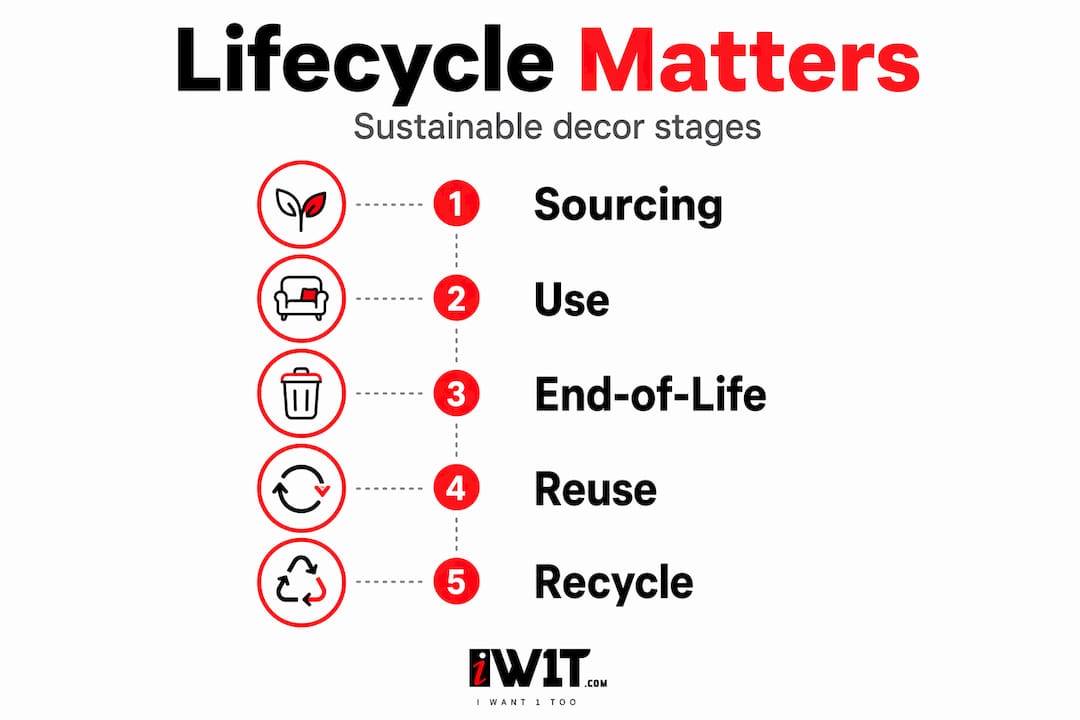
A reused mattress, according to carbon accounting research, achieves the lowest footprint of all treatment options. That logic applies to sofas, rugs, artwork, and lighting too. Buying pieces that hold their value and condition long enough to be passed on is one of the most impactful choices you can make.
How to make your home decor more sustainable in practice
The good news is that making better choices is entirely possible, even while the industry is still catching up.

Buying fewer, better pieces and extending the life of what you already own is one of the most practical methodologies for sustainable decorating. It sounds simple, but it runs counter to a retail industry built on seasonal trends and fast turnover. Resistance to that cycle is itself a form of sustainability activism.
Here are the most effective strategies for UK homeowners and renters:
- Invest in quality over quantity. One well-made ceramic lamp that lasts 20 years is far more sustainable than four cheaper alternatives purchased over the same period. Look for solid joinery, quality hardware, and materials that age well.
- Repair before replacing. A scratched wooden table can be sanded and refinished. A chipped vase can be repaired with kintsugi technique, the Japanese art of repairing with gold. Faded textiles can be overdyed. Skills matter here, and tutorial resources are widely available.
- Shop second-hand first. Charity shops, boot sales, estate clearances, and online platforms offer huge volumes of quality pre-owned home decor. Many items from the 1970s to 1990s were made to standards rarely matched today.
- Know your disposal options before you buy. Research whether your local council accepts the item type, whether a charity shop would take it, and whether the brand offers take-back. If the answer to all three is no, reconsider the purchase.
- Prioritise transparency. UK furniture sustainability benchmarking suggests sustainability activity in the sector is present but uneven, meaning consumers need to check product-level evidence rather than trusting brand-wide claims.
Additional practical habits that compound over time:
- Choose paint with low or zero VOC content for walls and furniture refinishing.
- Use natural fibre rugs (wool, jute, sisal) over synthetic alternatives where possible, and check that they are undyed or naturally dyed.
- When updating a room, consider reupholstering existing furniture rather than purchasing new pieces.
- Keep an eye on brands offering modular or upgradeable designs, where individual components can be replaced rather than the whole product.
If you are planning a refresh, exploring how to decorate for comfort while keeping sustainability at the centre is entirely compatible. Many 2026 trends, as covered in current décor directions, favour natural textures, warm tones, and timeless pieces over disposable seasonal statements.
Pro Tip: Prioritise brands that offer take-back schemes and publish product-level sustainability data. These two factors combined signal genuine long-term commitment rather than surface-level positioning.
Why sustainable home decor is more about trade-offs than perfection
We will be honest with you: there is no such thing as a perfectly sustainable home decor purchase. The goal is not purity. It is progress, and understanding that distinction makes the whole process far less overwhelming.
Every material involves trade-offs. Reclaimed wood avoids new deforestation but may require chemical stripping or treatment. Organic cotton is grown without pesticides but uses significant water. Bamboo grows rapidly but is often processed with chemical binders to form boards. Treating sustainability as a set of trade-offs across lifecycle stages, rather than a binary pass/fail, is actually a more robust approach than trusting any single label or visual cue.
What we find far more valuable than chasing certification logos is cultivating genuine curiosity about the things you bring into your home. Ask where it came from. Ask how long it should last. Ask what you will do with it when it is no longer needed. These questions are uncomfortable for brands that cannot answer them, and that discomfort is informative.
Personal innovation often outpaces industry schemes. A homeowner who reupholsters a vintage armchair, refinishes an old shelf, or sources lighting from a reclamation yard is making a more meaningful environmental contribution than someone who purchases a new "sustainable" item from a brand with opaque supply chains. Your creativity and willingness to think differently is genuinely powerful.
Continual improvement matters more than a perfect label. Exploring the relationship between wellbeing and home décor reveals that the spaces we create affect us daily. Doing that thoughtfully, with materials chosen for quality and longevity, is good for you and the planet simultaneously. There is no conflict there.
Ready to make a change? Your next step towards sustainable style
Sustainability does not have to mean compromise on style or practicality.
At IW1T, we have carefully selected a range of home décor that balances quality, aesthetic value, and practical purpose. We understand that decision fatigue is real, especially when every product claims to be the ethical choice. Our curated sustainable home décor takes the guesswork out of the process by bringing together pieces chosen for their durability, design, and genuine lifestyle value. Whether you are starting from scratch or simply adding considered touches to an existing space, our range is designed to support your style journey without overwhelming you with choices. Explore what is available and find pieces that will still be working hard in your home years from now.
Frequently asked questions
Are sustainable home décor products more expensive?
They may cost more upfront but are designed to last longer, reducing the need for frequent replacements. Buying fewer, better pieces and extending the life of what you own consistently proves more economical over time.
How can I tell if a home décor product is genuinely sustainable?
Check for clear evidence like third-party certifications, material transparency, and credible take-back schemes, not just "eco" labels. Greenwashing guidance consistently advises scrutinising the evidence behind any environmental marketing term.
Is it better to buy new sustainable décor, or refresh what I have?
Extending the life of what you own by repairing or updating it is often the most sustainable option. A practical sustainable approach favours longevity and reuse over new purchasing, even when the new item carries eco credentials.
Are there UK-specific standards for sustainable home décor?
The UK Green Claims Code sets guidelines for environmental marketing, and many products may carry recognised labels like FSC or GOTS. Scrutinising sustainability claims against these codified standards is a reliable way to separate genuine credentials from marketing language.