
Aesthetics shape far more than what looks nice on a shelf. The role of aesthetics in lifestyle runs through your mental health, your habits, your motivation, and the quality of your daily experience in ways that science is only beginning to fully map. Most people treat aesthetic choices as a finishing touch, something you attend to after the practical matters are sorted. That instinct is exactly backwards. Your surroundings, your sensory environment, and your personal design choices are actively working on your brain and body every single hour of every day, whether you are paying attention to them or not.
Table of Contents
- Key takeaways
- How aesthetics shape your mental health and mood
- Aesthetics as a driver of behaviour and motivation
- Aesthetics in home and workplace environments
- When aesthetic ideals work against you
- My honest take on aesthetics and everyday life
- Bring your aesthetic vision to life with Iw1t
- FAQ
Key takeaways
| Point | Details |
|---|---|
| Aesthetics affect brain chemistry | Aesthetic engagement triggers dopamine, oxytocin, and cortisol responses, producing measurable physiological change. |
| Multisensory design multiplies benefits | Combining sound, lighting, scent, and colour creates stronger well-being effects than visual beauty alone. |
| Context shapes aesthetic impact | Décor upgrades work best when paired with supportive social and cultural environments, not used in isolation. |
| Rigid aesthetic ideals carry risks | Prescriptive lifestyles like "clean girl culture" can increase anxiety and self-monitoring rather than improving well-being. |
| Flexible practice is the goal | Identity-inclusive, process-oriented aesthetics support genuine self-expression and mental health over time. |
How aesthetics shape your mental health and mood
The science here is more concrete than most people expect. Biophilic art environments produce statistically significant improvements in both depression and anxiety, with research attributing 67% of depression symptom improvement and 72% of anxiety reduction to attention restoration, stress reduction, and perceived environmental quality. These are not abstract benefits. They are measurable outcomes linked to specific design choices.
Part of what drives this is neurochemistry. Aesthetic experience activates reward and stress circuits in the brain, changing levels of dopamine, oxytocin, and cortisol while also shifting heart rate and breathing patterns. You are not passively observing beauty. Your nervous system is responding to it in real time.
What makes this even more compelling is that visual beauty is only part of the story. Multisensory congruence, meaning the alignment of sound, colour, lighting, and scent, amplifies emotional well-being effects beyond what any single sensory element can achieve on its own. Research shows that pairing ocean sounds with blue light, or rain sounds with warm red light, creates measurably positive emotional responses. Mismatched combinations, by contrast, can undermine the effect entirely.
Hospitals in the United States have put this into practice with dedicated "Recharge Rooms." These spaces use multisensory nature-like design to create immersive, calming environments, and the results are striking. Healthcare workers using the rooms reported a 59.1% reduction in stress, a 29.6% increase in hopefulness, and a 35.1% boost in alertness. Practitioners in this space treat aesthetics as an experience design problem targeting emotional outcomes, not a checklist of pretty objects.
- Lighting colour and intensity directly affect cortisol levels and alertness throughout the day
- Soundscapes, including birdsong, water, and gentle ambient sound, support attention restoration without requiring conscious effort
- Scent has one of the most direct neurological pathways to emotional memory and mood regulation
- Visual complexity versus calm in a space influences cognitive load and mental fatigue
Pro Tip: If you want to test multisensory design in your own home, start with indoor lighting before anything else. Lighting affects every other sensory experience in a space and gives you the most immediate feedback on mood and comfort.
Aesthetics as a driver of behaviour and motivation
Understanding why beautiful environments make you feel good is one thing. Understanding how they change what you actually do is where the importance of aesthetics becomes genuinely fascinating.
Neuroaesthetics research has established that aesthetic gratification enhances engagement, motivation, and neuroplasticity. Aesthetic pleasure is not a side effect of a good experience. It is a central mechanism that drives cognitive and emotional improvement. When you find your surroundings genuinely beautiful and meaningful, your brain becomes more receptive, more curious, and more willing to sustain attention.

There is a nuance worth understanding here. Aesthetic pleasure is enhanced when environments and objects have high interpretability. The research points to meaning and comprehension as drivers of positive affect, which is why a thoughtfully designed room with a coherent sensory identity tends to feel better than a space filled with expensive but random items. You are not simply responding to cost or novelty. You are responding to meaning.
Here is a practical sequence for creating aesthetic environments that genuinely motivate rather than simply impress:
- Define the emotional outcome you want. Calm and restoration require different choices than focus and energy. Start with a feeling, not a look.
- Choose a coherent sensory identity. Pick colours, textures, and materials that share a common emotional register. Contrast for contrast's sake dilutes meaning.
- Layer sound and scent deliberately. These are the most underused tools in home aesthetics and among the most powerful for mood and motivation.
- Remove ambiguity in high-focus spaces. Cluttered, visually complex environments increase cognitive load and reduce the quality of attention you can bring to work or creative tasks.
- Revisit and adjust seasonally. Aesthetic needs shift with light levels, temperature, and personal circumstances. Treat your space as a living design rather than a finished product.
Pro Tip: When choosing aesthetic pieces for your home, ask yourself whether each item adds meaning or merely fills space. Objects with personal resonance consistently outperform generic "stylish" items for sustained well-being.
Aesthetics in home and workplace environments
The impact of design on lifestyle is not limited to museums, hospitals, or curated Instagram interiors. It operates wherever you spend significant time, including your home, your office, and any space that forms a backdrop for your daily routine.
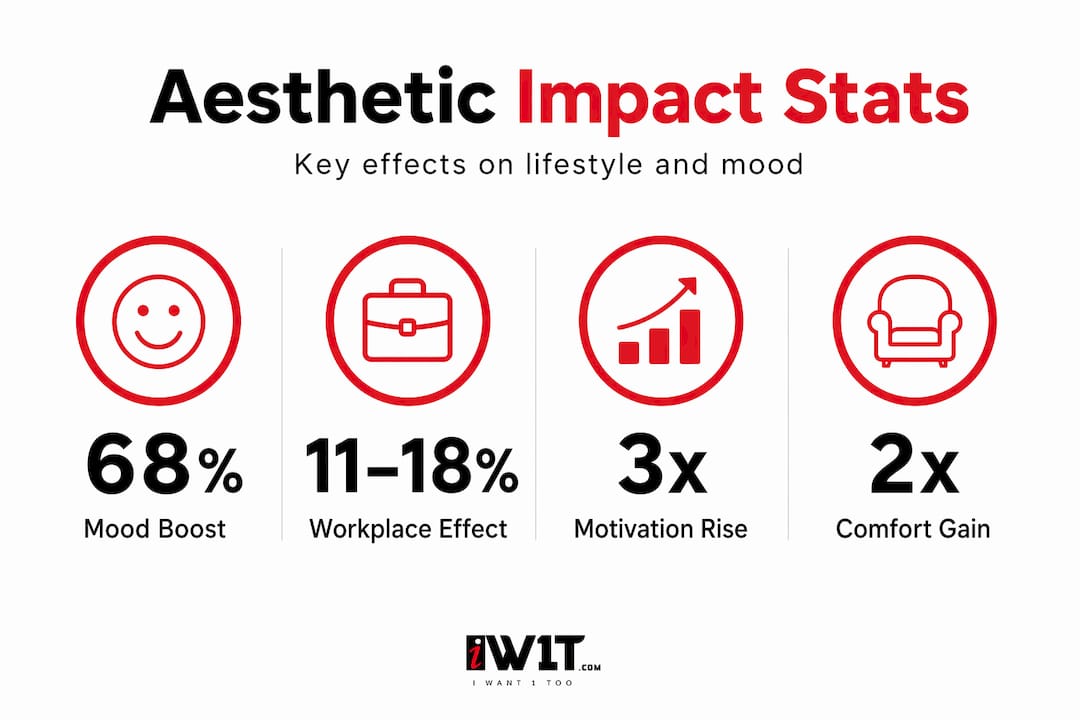
Research on workplace environments reveals something important. Organisational aesthetics mediate 11 to 18% of the effects of leadership, emotional intelligence, and organisational support on workplace well-being. Aesthetics function as a contextual resource, transmitting part of the impact of good leadership and culture into felt experience. A beautifully designed office under poor leadership still produces poor outcomes. But a well-led team in an aesthetically considered space performs measurably better than the same team in a neglected one.
The same principle applies at home. Aesthetic quality in a living space shapes comfort, relaxation, and mood in ways that accumulate across every day. How your home looks and feels is not decorative background noise. It is a continuous environmental input affecting your baseline emotional state.
| Aesthetic factor | Effect when considered | Effect when neglected |
|---|---|---|
| Lighting quality | Supports alertness, calm, and circadian rhythm | Increases fatigue, eye strain, and mood disruption |
| Colour coherence | Creates psychological safety and visual ease | Generates low-level visual stress and cognitive friction |
| Soundscape control | Reduces distraction and supports focus or rest | Raises cortisol and fragments attention |
| Material texture and comfort | Reinforces physical relaxation and sensory satisfaction | Contributes to restlessness and physical unease |
The practical implication is significant. Home improvements focused on aesthetics yield the strongest results when they are paired with a genuine intention around how you want to feel, rather than how you want the space to look to others. Beauty directed outward and beauty designed for your own daily experience are different projects with different results.
- Warm, diffuse lighting in living areas consistently outperforms overhead fluorescent lighting for relaxation and mood
- Plants and natural textures (wood, stone, linen) reduce perceived stress even in small quantities
- Decluttering is an aesthetic act with psychological consequences, not simply a tidiness preference
When aesthetic ideals work against you
Here is a tension that rarely gets discussed honestly. The lifestyle aesthetics you encounter online, particularly those built around wellness, minimalism, or "clean living," carry genuine psychological risks when they shift from inspiration to prescription.
Rigid wellness aesthetics can promote self-monitoring, perfectionism, and anxiety rather than the well-being they appear to promise. "Clean girl culture" is a well-documented example. The aesthetic idealises a particular version of effortless health and beauty that is, in practice, neither effortless nor universally attainable. For many people, sustained exposure increases anxiety and avoidance behaviour rather than motivation.
The problem is not aesthetic aspiration. The problem is rigidity. When an aesthetic becomes a standard you must meet to feel acceptable, it has moved from self-expression into self-surveillance.
"Mindful, flexible aesthetic practice that supports self-compassion is key to avoiding the perfectionism and distress associated with contemporary aesthetic standards." — Melbourne Wellbeing Group
Practical ways to keep aesthetic choices healthy rather than harmful:
- Treat aesthetics as personal expression, not performance. Your space and style exist for your benefit, not for external validation.
- Distinguish between inspiration and comparison. Saving an image because it captures a feeling you want is different from measuring yourself against it.
- Prioritise process over outcome. The act of making your environment more beautiful is itself beneficial, regardless of whether it matches an idealised result.
- Build in identity flexibility. Your aesthetic should evolve with you, reflecting who you actually are rather than a fixed aspiration that may no longer fit.
My honest take on aesthetics and everyday life
I have spent years thinking about how environment shapes experience, and the thing I keep coming back to is how systematically people underestimate this. Most lifestyle conversations treat aesthetics as the reward you give yourself after you have handled the serious stuff. What the research makes clear, and what I have found to be true in practice, is that the serious stuff and the aesthetic stuff are the same stuff.
When I first started paying close attention to sensory environments, the shift I noticed most was not visual. It was the combined effect of light, sound, and texture working together. Getting those three elements into reasonable alignment changed how I felt in a space more than any single decorative choice ever did. That matches exactly what the multisensory research shows.
The other thing I want to say directly is that aesthetic living is not about achieving a particular look. The people I know who have the most genuinely satisfying home environments are not the ones with the most expensive or stylish objects. They are the ones who have made deliberate choices about how they want to feel, and then made those choices consistently. That is a practice, not a destination.
You do not need a complete redesign to feel the benefits. You need intention, a willingness to treat your sensory environment as worth attending to, and the patience to adjust as you learn what works for you.
— Scott
Bring your aesthetic vision to life with Iw1t

If this article has you rethinking how your space feels rather than simply how it looks, Iw1t is worth exploring. As a UK-based, family-run store, Iw1t curates a range of practical, stylish products designed to support exactly the kind of intentional lifestyle design this article describes. From home décor and lighting to wellness accessories and seasonal touches, everything is selected with genuine daily use in mind. The range also covers the outdoor design role of comfort and well-being, reflecting how aesthetics extend well beyond your four walls. Browse the collection and find pieces that earn their place in your space.
FAQ
What is the role of aesthetics in lifestyle?
Aesthetics shape daily mood, motivation, and well-being through sensory and neurochemical pathways. Your environment actively influences how you feel and behave, not just how things look.
How do aesthetics influence mental health?
Research links aesthetic environments to measurable reductions in anxiety and depression symptoms, partly through attention restoration and stress reduction mechanisms activated by biophilic and multisensory design.
Can interior design choices really affect your mood?
Yes. Lighting, colour, texture, and soundscape all trigger physiological responses including changes in cortisol, dopamine, and heart rate, making home décor choices directly relevant to emotional well-being.
Why can wellness aesthetics sometimes cause anxiety?
Rigid aesthetic ideals, such as those promoted by "clean girl culture," can shift from inspiration to self-surveillance, increasing perfectionism and anxiety rather than supporting genuine well-being.
Is multisensory design better than purely visual aesthetics?
Research confirms that combining sound, colour, lighting, and scent creates stronger emotional benefits than visual aesthetics alone, with sensory congruence being the key factor in maximising positive impact.