

Investing in home improvement is the most direct way to increase your property's financial worth, daily comfort, and personal satisfaction simultaneously. Whether you are planning to sell within two years or intend to stay for the next two decades, the case for upgrading your home is grounded in hard data and lived experience. The 2025 Remodeling Impact Report from the National Association of Realtors confirms that certain projects recover their full cost at resale, while also delivering measurable improvements in how much owners enjoy their homes every single day.
Why invest in home improvement for financial gain?
Home improvement investment, in property terms, refers to any planned expenditure that increases a home's market value, reduces deferred maintenance costs, or improves its competitiveness when listed for sale. The financial case is stronger than most homeowners realise, provided you choose projects wisely.
According to the NAR 2025 Remodeling Impact Report, a steel front door replacement recovers approximately 100% of its cost at resale, and a closet renovation returns around 83%. These figures are not outliers. They reflect a consistent pattern: targeted, visible improvements that buyers notice immediately tend to outperform expensive structural overhauls that buyers take for granted. A new front door costs a fraction of a kitchen extension but signals quality and care the moment a buyer arrives.
Deferred maintenance is the silent killer of property value. The CAAR 2025 Remodeling Impact Report confirms that visible maintenance issues, such as worn roofing, peeling paint, or damaged flooring, directly reduce buyer confidence and invite lower offers. Addressing these problems before listing protects your equity far more reliably than adding a luxury bathroom. Buyers discount aggressively for anything that looks neglected, even when the underlying structure is sound.
The risk of over-improving is real and worth understanding. Spending £80,000 on a kitchen in a street where comparable homes sell for £250,000 rarely returns full value. Project ROI depends strongly on alignment with neighbourhood comparables and buyer expectations, not simply on project cost. The most financially disciplined approach is to survey what similar homes in your area offer, then match or modestly exceed that standard.
Pro Tip: Before committing to any renovation, request sold prices for three comparable homes on your street from a local estate agent. This single step tells you exactly how much the market will reward your planned upgrade.
| Project type | Estimated cost recovery |
|---|---|
| Steel front door replacement | ~100% |
| Closet renovation | ~83% |
| Kitchen upgrade (mid-range) | ~60–70% |
| Window replacement | ~65–75% |
| Luxury bathroom addition | ~50–60% |
How does home improvement enhance comfort and daily living?
The financial argument for renovating is compelling, but for most homeowners it is not the primary motivation. Comfort and livability are the main drivers across home improvement spending in 2026, with essential repairs and functional upgrades dominating budget allocations. People renovate because they want to enjoy where they live, not only because they want to sell it for more.
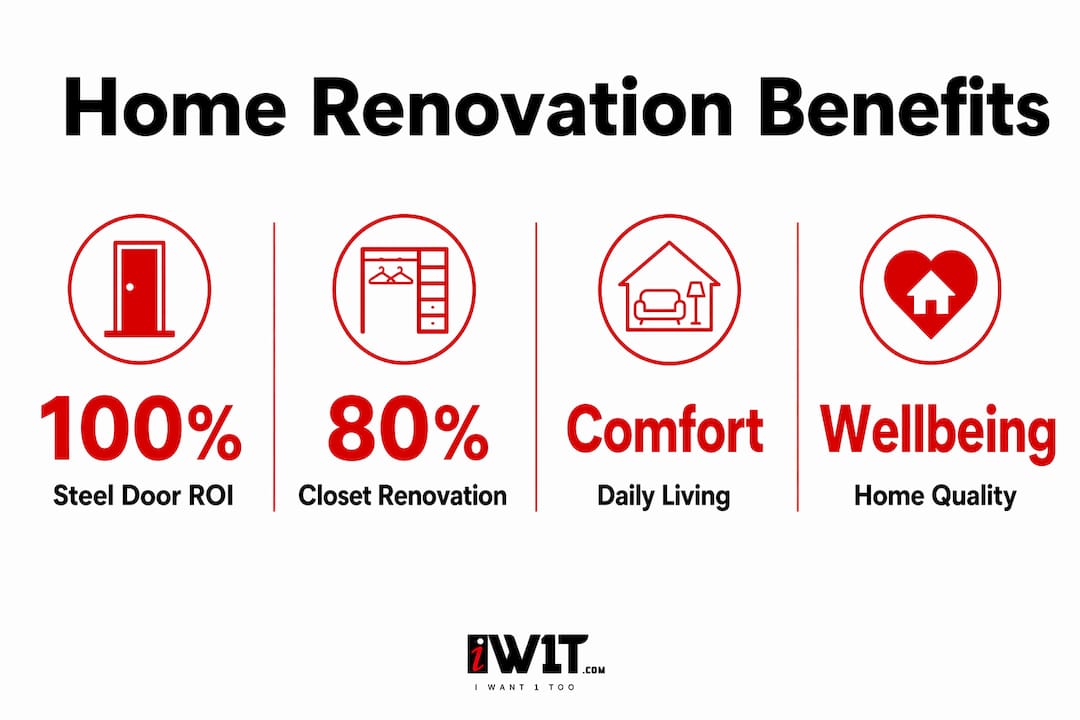
The 2025 Remodeling Impact Report introduced a Joy Score to quantify this emotional return. The data shows that 92% of homeowners would remodel more if cost were not a factor, and 46% reported enjoying their homes significantly more after completing renovations. That is nearly half of all renovating homeowners experiencing a measurable uplift in daily satisfaction. This matters because the home is where most people spend the majority of their waking hours outside of work.
Specific upgrades deliver outsized comfort gains relative to their cost. Consider the following:
- Kitchen improvements reduce daily friction. A well-organised kitchen with good lighting and functional storage changes how you cook, eat, and socialise at home.
- Roofing and window upgrades directly affect temperature, noise levels, and energy bills. Double or triple glazing cuts heat loss and reduces road noise, both of which affect sleep quality and general wellbeing.
- Flooring replacement transforms the feel of a room instantly. Replacing worn carpet with engineered wood or quality laminate makes a space feel cleaner, larger, and more welcoming.
- Bathroom refreshes improve the start and end of every day. Even modest changes, such as a new shower head, updated tiling, or better lighting, create a noticeably more pleasant experience.
Pro Tip: If your budget is limited, prioritise the rooms you use most. A better kitchen or a more comfortable living room delivers daily returns that a rarely-used guest bedroom simply cannot match.
The connection between home quality and personal wellbeing is well documented. Improving your home's comfort and wellbeing is not an indulgence. It is a practical investment in how you feel every morning you wake up there.
Renovate or relocate: when does staying make more sense?
The decision to renovate rather than move is one of the most consequential financial choices a homeowner faces. Renovation is not always cheaper than moving, particularly if your home is already priced near the top of its local market. However, in many circumstances, staying and improving is the more rational choice.
Here is a practical framework for making the decision:
- Calculate the true cost of moving. Estate agent fees typically run between 1% and 3% of the sale price. Add stamp duty on your next purchase, removal costs, legal fees, and potential mortgage arrangement fees. For a £400,000 home, moving can cost £20,000 to £30,000 before you have spent a penny on the new property.
- Assess what you actually need. If you need an extra bedroom and your plot allows an extension, building is almost always cheaper than buying a larger home in the same area. If you need to be in a different school catchment or closer to work, no renovation solves that.
- Consider market conditions. In a competitive market where suitable homes sell quickly and above asking price, moving is expensive and stressful. Renovating buys you time and adds value while you wait for conditions to shift.
- Think about long-term fit. If your home can be adapted to meet your needs for the next ten years, the cost of renovation is spread across a decade of improved living. That calculation almost always favours staying.
- Weigh emotional attachment. Proximity to schools, neighbours, and community matters. Separating the value from living benefits clarifies renovation decisions, and many owners prioritise functional and emotional returns when they plan to remain in their home.
Which home improvement projects offer the best returns?
Not all renovations are created equal. Strategic selection of projects aligned with buyer expectations consistently yields better returns than luxury or extensively customised remodels. The pattern across multiple reports is clear: first impressions and visible maintenance drive value more than hidden upgrades.
Exterior work commands the largest share of home improvement spending for good reason. Exterior projects represent the largest share of home improvement investments in 2026, reflecting how strongly kerb appeal influences buyer perception. A freshly painted exterior, a new front door, and tidy landscaping cost far less than a loft conversion but create the first impression that sets the tone for every viewing.
Windows are a particularly strong investment because they deliver on multiple fronts. They improve energy efficiency, reduce noise, update the appearance of the property, and are something buyers actively look for when assessing running costs. Upgrading to quality home décor and fixtures throughout the property compounds these gains by creating a coherent, well-maintained feel.
Kitchen upgrades remain consistently popular because buyers inspect kitchens closely and factor their condition heavily into offers. A mid-range kitchen renovation, meaning updated units, worktops, and appliances without going bespoke, typically recovers 60% to 70% of its cost at resale while dramatically improving daily use in the meantime. The key is avoiding over-specification. Handmade cabinetry and imported stone worktops in a mid-market home rarely return their cost.
Properly executed professional improvements increase buyer confidence and reduce time on the market. Shoddy workmanship, even on a well-chosen project, undermines the entire exercise. If you are investing in improvements with resale in mind, the quality of execution matters as much as the choice of project.
Key takeaways
Home improvement investment delivers the strongest returns when projects are chosen to match neighbourhood standards, address visible maintenance, and improve daily comfort rather than chase luxury upgrades.
| Point | Details |
|---|---|
| Financial returns vary by project | Steel front doors and closet renovations recover the most cost; luxury additions recover the least. |
| Comfort drives most renovation decisions | 46% of homeowners enjoy their homes more after renovating, making livability a primary return. |
| Moving costs are often underestimated | Estate agent fees, stamp duty, and legal costs can reach £30,000 on a £400,000 home. |
| Exterior upgrades deliver outsized value | Kerb appeal improvements cost less than structural work but create the strongest buyer first impression. |
| Execution quality matters as much as project choice | Professionally completed renovations increase buyer confidence and reduce time on the market. |
The case for renovating with your eyes open
I have seen homeowners spend £50,000 on a kitchen that added £20,000 to their sale price, and I have seen a £3,000 front door and fresh exterior paint add £15,000 to an asking price within a week of listing. The difference was not luck. It was understanding what buyers in that specific street actually valued.
The most common mistake I observe is treating renovation as a purely financial exercise. When you plan to stay in your home for five or more years, the emotional and functional returns matter enormously. A better kitchen makes every morning easier. A quieter bedroom improves your sleep. These are real returns that do not appear on a spreadsheet but accumulate every single day.
My honest caution is about timing and budget discipline. Renovating while under financial pressure, or rushing a project to meet a sale deadline, almost always produces worse outcomes. The best renovations are planned calmly, budgeted with a 15% contingency, and executed by tradespeople with verifiable references. The homeowners who get this right tend to be the ones who treat their home as a long-term asset rather than a short-term transaction.
— Scott
Ready to upgrade your home? Iw1t has you covered

At Iw1t, we know that the best home improvements often start with the right products. As a family-run UK store established in 2022, we have carefully curated a range of practical, stylish home improvement and décor products designed to make your space more comfortable, functional, and visually appealing. Whether you are refreshing a room on a modest budget or sourcing accessories to complement a larger renovation, you will find thoughtfully selected options that deliver genuine value. Browse the full range at Iw1t and discover products that support both the comfort and the character of your home.
FAQ
What home improvements add the most value to a property?
Steel front door replacements and closet renovations consistently top the returns list, with the NAR 2025 report citing cost recovery of approximately 100% and 83% respectively. Exterior maintenance, window upgrades, and mid-range kitchen refreshes also deliver strong returns relative to their cost.
Is it better to renovate or move to a larger home?
Renovating is typically more cost-effective when moving costs, including estate agent fees, stamp duty, and legal expenses, would consume £20,000 to £30,000 or more. The decision depends on whether your current home can be adapted to meet your needs and how competitive the local property market is.
Why do homeowners renovate if the financial return is not guaranteed?
Comfort, function, and enjoyment drive most renovation decisions, not purely financial ROI. The 2025 Remodeling Impact Report found that 46% of homeowners enjoyed their homes significantly more after renovating, which represents a genuine return regardless of resale value.
How do I avoid over-improving my home?
Research sold prices for comparable homes in your street before committing to any major project. Choosing projects aligned with neighbourhood standards avoids over-investment and targets buyer expectations effectively.
What is the biggest mistake homeowners make when renovating?
Neglecting visible maintenance in favour of cosmetic upgrades is the most common error. Buyers discount heavily for deferred maintenance issues such as worn roofing or damaged flooring, so addressing these first protects equity more reliably than adding premium features.