

Most people assume lifestyle design means quitting your job, selling everything, and moving to Bali. That misconception keeps a lot of people from engaging with one of the most genuinely useful personal development concepts available today. What is lifestyle design, really? At its core, it is the deliberate practice of shaping your daily life around your own values and priorities rather than simply following the path society hands you. It is not a single dramatic decision. It is a continuous, considered process, and it is far more accessible than most people realise.
Table of Contents
- Key takeaways
- What is lifestyle design? Core concepts and origins
- Principles and methods behind the practice
- Comparing the main frameworks
- Practical steps to start designing your life
- My honest take on lifestyle design
- Products that support your lifestyle goals
- FAQ
Key takeaways
| Point | Details |
|---|---|
| Lifestyle design is intentional | It means shaping life around personal values, not societal defaults or inherited expectations. |
| Two major frameworks exist | Tim Ferriss and Stanford's Life Design Lab offer complementary but distinct approaches worth understanding. |
| Iteration beats perfection | Testing small life experiments reduces anxiety and builds better decisions than waiting for a perfect plan. |
| Constraints are part of the process | Acknowledging finances, health, and obligations makes lifestyle design realistic rather than wishful thinking. |
| It never truly finishes | Lifestyle design is a continuous practice of small, deliberate choices made consistently over time. |
What is lifestyle design? Core concepts and origins
The formal term most practitioners use is intentional living, though "lifestyle design" has become the widely recognised shorthand since Tim Ferriss brought it into mainstream conversation with The 4-Hour Workweek. That book spent four years on the bestseller list, sold over 2.1 million copies, and was translated into 40 languages. It introduced millions to the idea that work, time, and income could be restructured around life rather than the other way around.
But the lifestyle design concept runs deeper than Ferriss. Stanford University's Life Design Lab, founded by Bill Burnett and Dave Evans, applies design thinking principles to personal life choices. Their academic approach treats your life as a prototype rather than a fixed plan, encouraging experimentation over certainty.
At its most straightforward, lifestyle design means replacing a deferred future with present-day intentional choices. It is about reshaping routines, relationships, income structures, and environments to reflect what genuinely matters to you, not what is expected of you.
A few things lifestyle design is not:
- A one-time overhaul or grand escape from responsibility
- Exclusively about becoming a digital nomad or working four hours a week
- Reserved for people with wealth, freedom, or no obligations
- A self-help shortcut with guaranteed outcomes
The lifestyle design concept is available to anyone willing to examine their choices honestly and adjust them deliberately over time.
Principles and methods behind the practice

Understanding how to design your lifestyle requires more than inspiration. It requires a working methodology. Both the Ferriss school and Stanford's approach draw on design thinking, a process originally developed for product and service design that translates surprisingly well to personal life planning.
The core cycle works like this:
- Empathise with yourself. Examine how you currently spend your time, what drains you, and what genuinely energises you. This is not journalling for its own sake. It is data collection.
- Define your values and priorities. What does a good day actually look like for you? Not in abstract terms, but in concrete, observable ones.
- Ideate multiple possible futures. Stanford's Odysseys method asks you to map out three distinct five-year life versions, each with different assumptions about what you might pursue.
- Prototype on a small scale. Talk to people living versions of your possible futures. Try a weekend experiment. Take on a freelance project. Gather real information before committing.
- Test and iterate. Adjust based on what you learn. The goal is not to find the perfect answer but to make progressively better choices.
One of the most important lifestyle design principles is that attempting a single perfect plan leads to paralysis. Exploration, by contrast, builds confidence and reduces anxiety. The design thinking shift is from asking "What is the meaning of life?" to asking "How do I find meaning in life?". That reframe alone changes everything, because the second question is answerable through daily choices and experiments.
Pro Tip: When identifying your values, avoid abstract words like "freedom" or "success." Instead, describe what a specific Tuesday morning looks like when life feels right. Concrete images reveal more than abstract ideals.
Lifestyle design principles also require you to account for constraints honestly. Health conditions, financial realities, family obligations, and geography all shape what is feasible. Ignoring them produces fantasy, not design.
Comparing the main frameworks
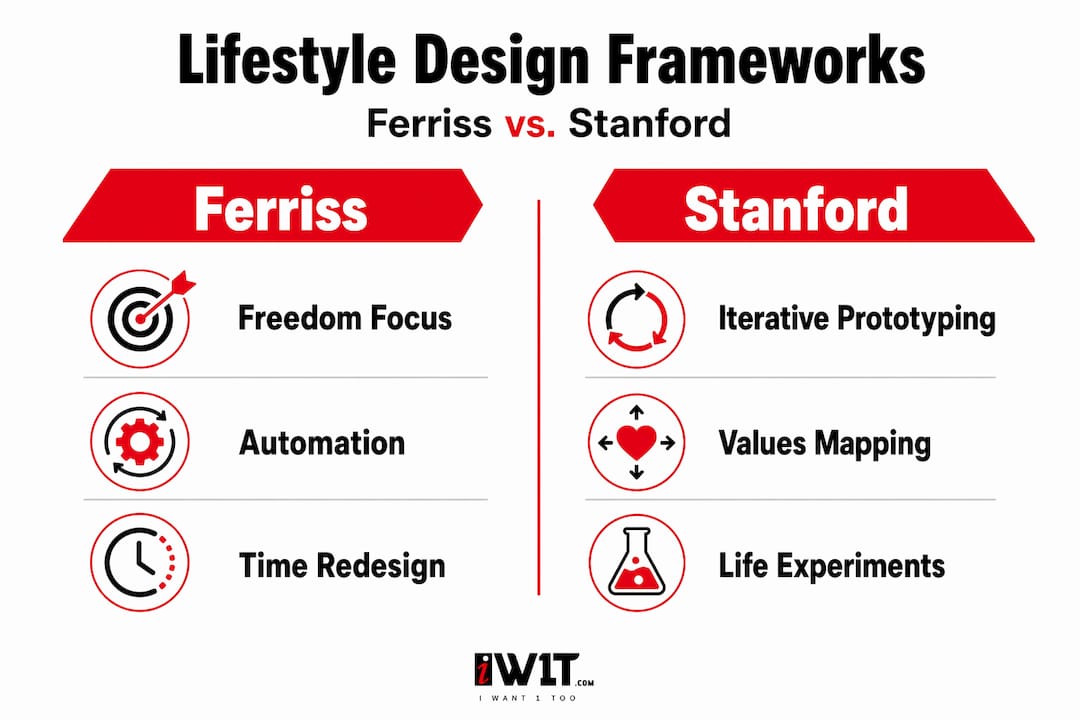
The two most widely referenced frameworks in lifestyle design are Tim Ferriss's approach and Stanford's Life Design methodology. They share a rejection of the default path but differ meaningfully in focus and method.
| Framework | Core focus | Method | Best suited for |
|---|---|---|---|
| Tim Ferriss / The 4-Hour Workweek | Time and income freedom | Outsourcing, automation, mini-retirements | People seeking structural freedom from traditional employment |
| Stanford Life Design Lab | Meaning, flow, and engagement | Odyssey plans, prototyping, reflection | People seeking clarity about direction and purpose |
| Integrated approach | Freedom and meaning | Combines structural redesign with values-based exploration | People who want both practical freedom and a sense of purpose |
Ferriss frames freedom as multidimensional, encompassing time, mobility, and alignment, not just location independence. His critics sometimes reduce his work to "work less, travel more," but the underlying argument is about reclaiming control over how you spend your finite time.
Stanford's approach is less prescriptive about outcomes. It does not tell you what a good life looks like. It gives you tools to figure that out for yourself through structured reflection and low-risk experimentation. The Odysseys method, in particular, is worth trying even if you feel settled. Mapping three genuinely different five-year futures, including one that assumes your current path disappears, reveals assumptions you did not know you were making.
Used together, these frameworks complement each other well. Ferriss gives you the structural tools to create space. Stanford gives you the reflective tools to fill that space with something meaningful.
Practical steps to start designing your life
Knowing the theory is useful. Actually applying lifestyle design strategies to your own life is where most people stall. Here is how to move from concept to practice without needing to quit your job or upend everything at once.
Start with a values audit. Write down the ten things that matter most to you. Then look at your calendar and bank statement from the past month. The gap between those two lists is your starting point. Most people find the gap is significant.
Run lifestyle experiments. The three-phase process of clarifying what you want, planning steps, and taking action works best when the steps are small and testable. Want to work remotely? Negotiate one day a week before assuming it requires a new job. Want to exercise more? Commit to two weeks of 20-minute morning sessions before designing an elaborate fitness programme.
Apply the 80/20 principle ruthlessly. Twenty per cent of your activities produce eighty per cent of your meaningful results. Identifying and cutting the low-value eighty per cent creates genuine space for what matters. This applies to commitments, relationships, and work tasks equally.
Here are practical lifestyle design tips for getting started:
- Audit one area of your life per month rather than attempting a total overhaul
- Keep a weekly reflection note: what felt aligned, what felt draining
- Prototype before committing. Try before you decide
- Talk to people already living versions of your possible futures
- Acknowledge your constraints early and work with them, not around them
Pro Tip: Set a 90-day experiment with one specific change, such as waking an hour earlier, working from a café two mornings a week, or cutting one regular commitment. Treat it as research, not a permanent decision. You will learn more in 90 days than in years of planning.
The importance of lifestyle design lies not in the dramatic moments but in the accumulation of small, deliberate choices. Consistent small decisions over time shape a life far more than any single bold move. That is the part most lifestyle content glosses over, and it is the part that actually works.
My honest take on lifestyle design
I have spent a lot of time reading about lifestyle design and watching how people actually apply it. The biggest mistake I see, repeatedly, is treating it as a one-time event. Someone reads a book, feels inspired, makes one big change, and then wonders why nothing feels fundamentally different six months later.
What I have found actually works is far less dramatic. It is the person who spends three months quietly renegotiating their working hours. The person who stops attending two social commitments that drain them and uses that time for something they genuinely value. The person who redesigns their morning not because a podcast told them to, but because they noticed they feel better when they start the day on their own terms.
The "big leap" narrative is seductive, but it often sets people up to wait for the right moment rather than act now. In my experience, the right moment is always made, never found. I also think the obsession with freedom as the goal misses something. Freedom without alignment to your actual values just feels like a different kind of drift. The real work is figuring out what you want your days to feel like, then making small, persistent adjustments until they do. That is less exciting to write about, but it is what actually changes lives.
You can explore more ideas on this through Iw1t's lifestyle inspiration guide, which covers practical ways to align your routines with what genuinely matters to you.
— Scott
Products that support your lifestyle goals
Lifestyle design is not just about mindset shifts. The physical environment you inhabit and the tools you use every day either support your intentions or quietly undermine them.
At Iw1t, a family-run UK store established in 2022, the focus has always been on products that genuinely improve daily living rather than add clutter. From home décor that supports comfort to wellness accessories that make healthy routines easier to maintain, every item is chosen with the same question in mind: does this make everyday life better? If you are redesigning how you live, it makes sense to surround yourself with things that reflect that intention. Browse the full range at Iw1t and find practical, thoughtfully selected products that align with the life you are building.
FAQ
What does lifestyle design mean?
Lifestyle design means deliberately shaping your daily life around your personal values and priorities rather than following default societal expectations. It is an ongoing, iterative process rather than a single decision.
Who created the lifestyle design concept?
Tim Ferriss popularised the term through The 4-Hour Workweek, though Stanford's Life Design Lab developed a parallel academic framework using design thinking principles applied to personal life choices.
How do I start designing my lifestyle?
Begin with a values audit, compare it honestly against how you currently spend your time, then run small, low-risk experiments to test changes before committing to them fully.
Is lifestyle design only for people who want to travel or quit their jobs?
No. While some practitioners pursue location independence, lifestyle design applies equally to redesigning routines, relationships, working hours, and daily habits within any existing life structure.
How long does lifestyle design take?
Lifestyle design is a continuous practice rather than a fixed project. Small, consistent adjustments over months and years produce more lasting change than any single dramatic overhaul.