
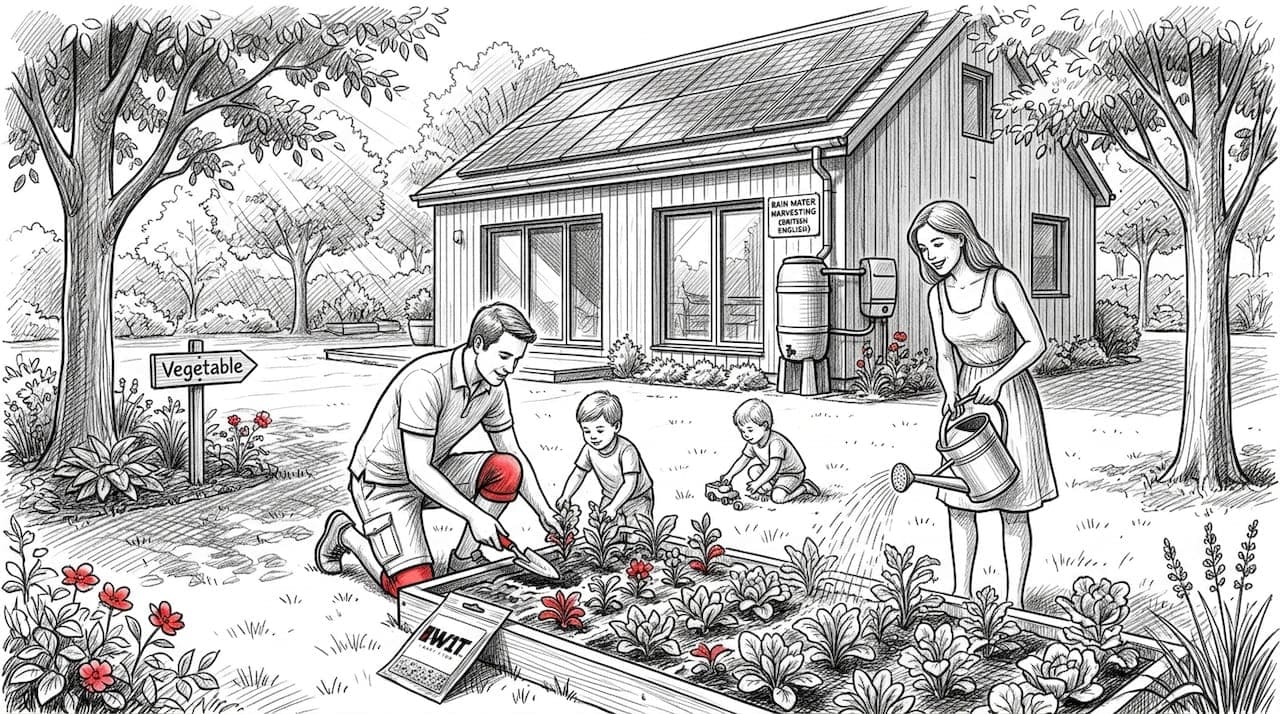
An eco-friendly home is a residential building designed as an integrated system to minimise its environmental impact across energy use, water consumption, materials, and indoor air quality throughout its entire lifecycle. The industry term for this approach is sustainable housing, and it goes far beyond fitting solar panels or swapping to LED bulbs. Bioclimatic design, high-performance building envelopes, EPA WaterSense-certified fixtures, and low-VOC materials all work together to reduce resource use while actively improving the health and comfort of the people living inside. Understanding what makes a home eco-friendly is the first step towards making choices that matter, whether you are building from scratch or improving a property you already own.
What is an eco-friendly home, really?
An eco-friendly home is designed as a system that reduces environmental impact by addressing energy, water, and materials throughout the home's lifecycle, using bioclimatic strategies to harness local climate for heating, cooling, and daylighting. That definition matters because it shifts the conversation away from individual gadgets and towards whole-building performance. A house with solar panels but poor insulation, draughty windows, and toxic paint is not genuinely sustainable. It is simply a conventional home with one green feature bolted on.
Bioclimatic design is the practice of orienting and shaping a building so that the local climate does the heavy lifting. South-facing glazing captures winter sun in the UK. Deep roof overhangs shade the same windows in summer. Thermal mass in concrete or stone floors absorbs daytime heat and releases it at night. These passive strategies reduce the mechanical load on heating and cooling systems before any technology is introduced, which is why they sit at the core of genuine sustainable housing.
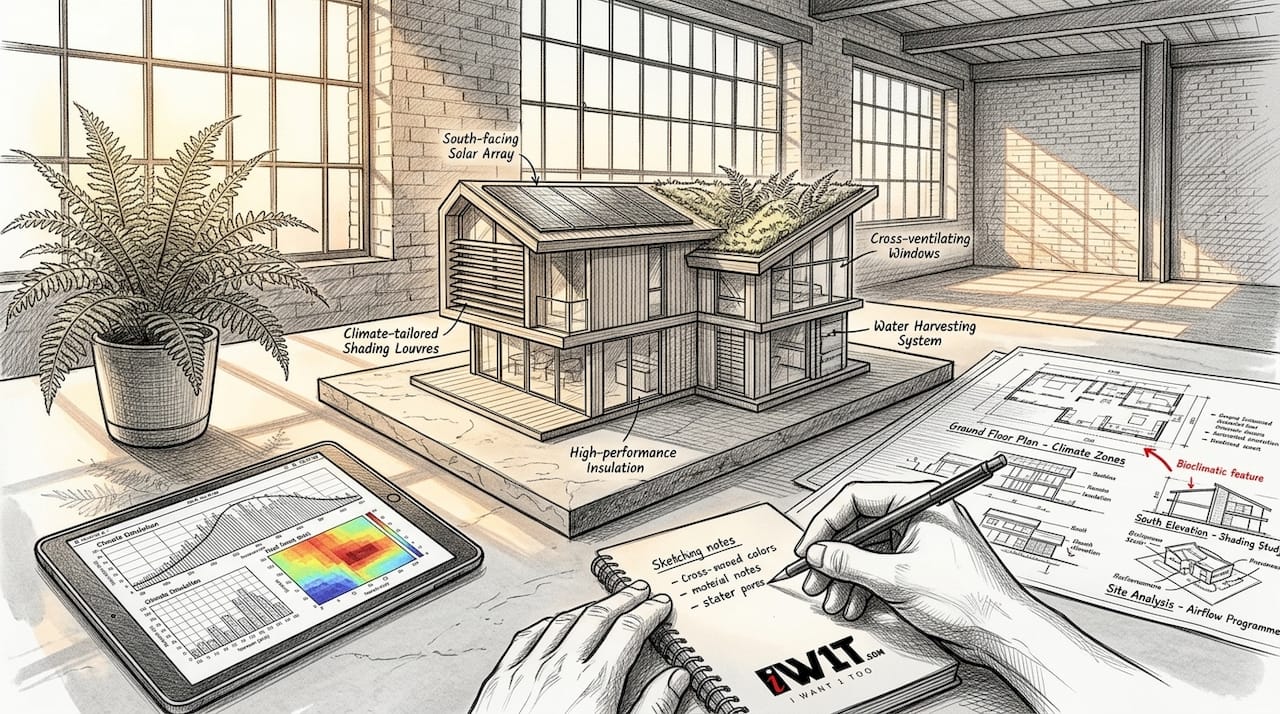
The lifecycle perspective is equally significant. A home's environmental footprint includes the embodied carbon in its construction materials, the operational energy consumed over decades of use, and the waste generated at the end of its life. Timber from certified sources, recycled insulation, and reclaimed brick all carry lower embodied carbon than virgin concrete or aluminium. Choosing materials with this in mind is as much a part of eco-friendly home design as choosing an efficient boiler.
What features characterise an eco-friendly home?
The fabric-first building approach designs a super-insulated, airtight envelope with mechanical ventilation, drastically reducing the need for conventional heating and cooling. This principle underpins Passive House standards and is the single most important structural decision in any eco-friendly new build. Get the envelope right, and every other system in the house becomes smaller, cheaper, and more effective.
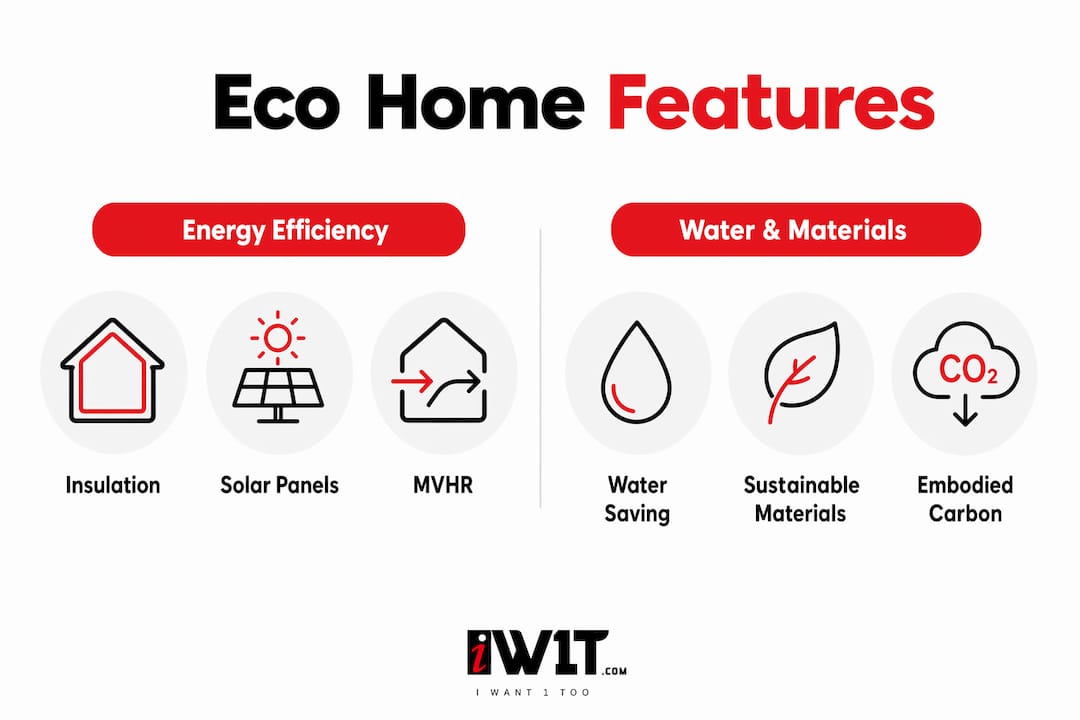
Beyond the structure, eco-friendly home features typically include:
- High-performance windows and doors with triple glazing and thermally broken frames to eliminate cold bridging and condensation.
- Renewable energy sources such as photovoltaic solar panels, air source heat pumps, or ground source heat pumps, which replace fossil fuel combustion with low-carbon alternatives.
- Energy-efficient appliances rated A or above under UK energy labelling, covering white goods, lighting, and heating controls.
- Water-efficient fixtures certified to EPA WaterSense standards or the UK's equivalent WRAS-approved products, including low-flow showerheads, dual-flush toilets, and aerated taps.
- Low-VOC and non-toxic materials including paints, adhesives, flooring, and insulation that do not off-gas harmful chemicals into the living space.
- Healthy indoor air strategies covering source control during construction, mechanical ventilation with heat recovery (MVHR), and supplementary air filtration where needed.
Pro Tip: Start with the building fabric before specifying any technology. A well-insulated, airtight home with MVHR needs a smaller heat pump, fewer solar panels, and a simpler ventilation system, which means lower upfront costs and lower running costs from day one.
Water efficiency deserves particular attention because it is often underestimated. WaterSense-labelled products saved 1.2 trillion gallons of water in 2023 alone, and a single certified showerhead can save up to 2,700 gallons per year. That saving also reduces the energy required to pump, heat, and treat that water, making water efficiency a direct contributor to energy savings as well.
How do eco-friendly homes improve health and comfort?
Indoor air quality is one of the most compelling and least discussed benefits of eco-friendly homes. The EPA identifies three strategies for improving it, in order of effectiveness:
- Source control. Remove or reduce the pollutant at its origin. This means specifying low-VOC paints, formaldehyde-free board products, and natural fibre flooring rather than synthetic carpets during construction or renovation.
- Ventilation. Dilute and remove pollutants by bringing in fresh outdoor air. MVHR systems do this continuously and efficiently, recovering up to 90% of the heat from outgoing stale air before it leaves the building.
- Air filtration. Supplement ventilation with HEPA or activated carbon filters to capture particulates, allergens, and residual chemical compounds that source control and ventilation alone cannot fully address.
"Source control is the most effective way to improve indoor air quality. Using green materials without a ventilation plan is insufficient." — US EPA Indoor Air Quality guidance
The practical consequence of this hierarchy is significant. Many homeowners buy an air purifier and consider the problem solved, but if the materials in the walls, floors, and furniture are continuously off-gassing VOCs, a purifier is fighting a losing battle. The healthy homes approach focuses beyond energy to improve the indoor environment holistically, reducing exposure to VOCs and allergens through material selection first, then ventilation, then filtration. Improving indoor air quality in this sequence produces measurable gains in sleep quality, respiratory health, and cognitive performance for occupants.
Thermal comfort is the other major health dividend. A well-insulated, draught-free home maintains even temperatures without hot and cold spots, which reduces the physical stress of temperature fluctuation and eliminates the damp conditions that encourage mould growth. Mould is a direct cause of respiratory illness, and its absence in a well-built eco home is not a minor benefit. It is a significant one.
New build vs retrofit: which eco approach suits you?
The two main routes to a sustainable home are new construction and retrofitting an existing property. They involve different constraints, costs, and opportunities.
| Factor | New build | Retrofit |
|---|---|---|
| Fabric performance | Designed from scratch to Passive House or equivalent standard | Limited by existing structure; insulation and airtightness upgrades are possible but costly |
| Cost efficiency | Higher upfront cost, lower lifetime running costs | Phased improvements spread cost; some measures have short payback periods |
| Disruption | None during occupation | Significant disruption during major works such as external wall insulation |
| Technology integration | Systems sized correctly for the envelope from day one | Risk of oversizing heat pumps or solar if fabric is not improved first |
| Water harvesting | Rainwater cisterns and greywater recycling designed in easily | Retrofitting tanks and pipework is feasible but requires planning |
A 2026 net-positive certified Passive House in the Washington DC area demonstrates what new construction can achieve. The project used airtight insulation, solar panels, MVHR ventilation, and a 9,000-gallon rainwater cistern to exceed zero energy and zero water use, with battery backup sized for three days of autonomy. This is the ceiling of what the fabric-first approach makes possible.
For retrofit projects, the most cost-effective sequence is: loft insulation first, then cavity or external wall insulation, then draught-proofing, then heating system upgrades, then renewables. Skipping to solar panels or a heat pump before addressing the fabric is a common and expensive mistake. High-performance builders prioritise fabric and ventilation first to reduce load and system size, and the same logic applies to retrofits.
Pro Tip: Before specifying a heat pump for a retrofit, commission an airtightness test and a heat loss calculation. The results will tell you exactly which fabric improvements will reduce the required heat pump capacity, often by 30 to 50 percent, saving thousands on the installation.
How to create an eco-friendly home: practical steps
Creating or enhancing a sustainable home does not require a complete rebuild. These steps apply whether you are starting from scratch or working with an existing property:
- Audit your current performance. Use a home energy assessment or a smart meter to establish baseline energy and water consumption before making any changes. You cannot manage what you do not measure.
- Choose certified water-efficient fixtures. Replace showerheads, taps, and toilets with WaterSense-labelled or WRAS-approved equivalents. Water and energy efficiency are jointly optimised when you treat them as a single system rather than independent upgrades.
- Select low-VOC paints and sustainable materials. Brands such as Earthborn, Farrow and Ball's Eco range, and Auro offer low-VOC or zero-VOC formulations. For flooring, cork, bamboo, and FSC-certified timber carry lower embodied carbon than most synthetic alternatives.
- Incorporate smart home technologies. Smart thermostats such as Nest or Hive learn your schedule and reduce heating when the house is empty. Smart plugs identify phantom loads from devices left on standby, which account for a meaningful share of household electricity use.
- Use biophilic design elements. Indoor plants such as spider plants, peace lilies, and Boston ferns absorb some airborne pollutants and improve perceived air quality. Green roofs and living walls add insulation, manage rainwater runoff, and support urban biodiversity. Explore sustainable home décor ideas that combine aesthetics with genuine environmental benefit.
- Maintain systems regularly. MVHR filters need cleaning every three to six months. Heat pump refrigerant levels and solar panel output should be checked annually. Efficiency degrades silently without maintenance, and the savings disappear with it.
The broader principle is to treat an eco-friendly home as an evolving project rather than a one-time purchase. Each improvement builds on the last, and the compounding effect of multiple measures working together is always greater than the sum of individual parts.
Key takeaways
An eco-friendly home is defined by its whole-building performance across energy, water, materials, and indoor air quality, not by any single feature or technology.
| Point | Details |
|---|---|
| Fabric first | Prioritise insulation and airtightness before specifying any heating or renewable energy technology. |
| Water and energy are linked | Efficient water fixtures reduce energy for pumping, heating, and treatment simultaneously. |
| Source control leads on air quality | Specify low-VOC materials during construction before relying on ventilation or filtration. |
| Retrofit in sequence | Address loft insulation, then walls, then draught-proofing, then heating, then renewables. |
| Measure before you act | Audit energy and water use first so every upgrade targets a real, quantified problem. |
Why the "eco home" label is less useful than you think
The term "eco house" covers such a broad spectrum that it has become almost meaningless without qualification. I have seen properties marketed as eco-friendly because they have a single solar panel and a compost bin. I have also seen modest terraced houses with no renewable technology at all that outperform most new builds on energy use, simply because the owner invested in a thorough retrofit of the fabric and a well-specified MVHR system.
The insight I keep returning to is this: the most effective eco-friendly home decisions are the least visible ones. Nobody photographs their wall insulation or their airtightness membrane. But those choices determine whether the heat pump runs efficiently, whether the solar panels are sized correctly, and whether the indoor air is genuinely clean or just filtered after the fact.
My honest recommendation is to ignore the label entirely and focus on measurable performance criteria instead. Ask for an Energy Performance Certificate rating, a heat loss calculation, and an airtightness test result. Those three numbers tell you more about a home's true environmental credentials than any marketing description. The ergonomic and smart home accessories that make daily life more comfortable, such as smart thermostats and programmable heating controls, are worth adding once the structural foundations are solid. Not before.
Sustainable living is not a destination. It is a series of progressively better decisions, and the best time to make the next one is now.
— Scott
Practical eco-friendly products for your home

At Iw1t, we have curated a range of practical, stylish home products designed to support the kind of sustainable living described in this article. From smart energy monitors and water-saving accessories to air quality tools and home improvement essentials, every product in our catalogue is chosen with quality and everyday usefulness in mind. As a family-run UK business, we understand that building a greener home is a gradual process, and we want to make each step straightforward. Browse the full range at Iw1t and find the products that fit where you are in your eco-friendly home journey right now.
FAQ
What is the simplest definition of an eco-friendly home?
An eco-friendly home is a residential building designed to minimise its environmental impact through energy efficiency, water conservation, sustainable materials, and healthy indoor air quality across its entire lifecycle.
What makes a home eco-friendly rather than just energy-efficient?
Energy efficiency is one component, but a genuinely eco-friendly home also addresses water use, embodied carbon in materials, indoor air quality, and bioclimatic design. A home that is energy-efficient but built with toxic materials and poor ventilation does not meet the full definition.
Are WaterSense fixtures worth fitting in a UK home?
WaterSense is a US EPA standard, but the performance benchmarks translate directly. WaterSense-labelled products saved 1.2 trillion gallons of water in 2023, and UK-equivalent WRAS-approved low-flow fixtures deliver comparable savings while reducing water heating energy costs.
Is it better to build a new eco home or retrofit an existing one?
Both are valid, and the right choice depends on budget and circumstance. New builds allow fabric-first design from the outset, but a well-sequenced retrofit addressing insulation, airtightness, and ventilation before heating upgrades can achieve comparable performance at lower total cost.
How do I improve indoor air quality in an existing home?
The EPA recommends source control first: replace high-VOC materials with low-VOC alternatives. Then improve ventilation by fitting MVHR or trickle vents, and supplement with HEPA air filtration if needed. Ventilation without source control produces only partial results.