
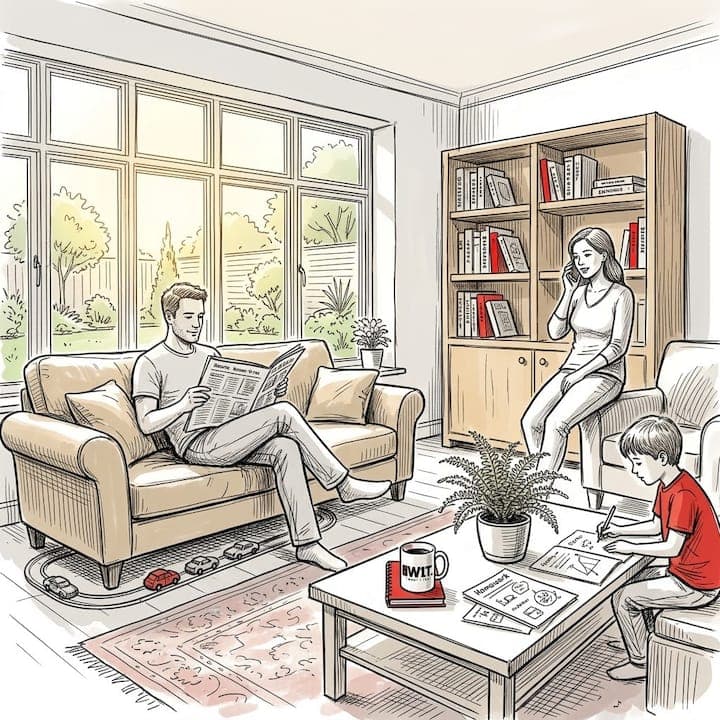
Modern home style has a reputation problem. For years, it's been written off as cold, bare, and uninviting — all bare concrete and empty shelves. But that version of minimalism is fading fast, and what's replacing it is genuinely exciting. In 2026, British homeowners are discovering that modern design can be warm, tactile, and deeply personal. This guide unpacks what modern home style actually means today, how it's shifting across the UK, and how you can apply it in your own space without sacrificing comfort or character.
Table of Contents
- Defining modern home style: Key features and principles
- How modern home style is evolving in the UK
- Smart, sustainable and practical: Core mechanics of modern UK homes
- Blending modern style with character: Adapting for UK homes
- Expert guidance: Making your modern home both liveable and personal
- Why the best modern homes put comfort and context first
- Enhance your modern home style with curated essentials
- Frequently asked questions
Key Takeaways
| Point | Details |
|---|---|
| Warm minimalism trend | The latest UK modern home style softens minimalist looks with textures, earthy colours, and layered lighting. |
| Practical and sustainable | Modern UK homes prioritise efficient layouts, smart technology, and sustainable materials for comfort and eco-friendliness. |
| Adaptability matters | With the right approach, any UK home—from terrace to historic—can adopt a modern style without sacrificing character. |
| Personal touches | Layered lighting, tactile elements, and curated personal items help your modern home feel inviting and unique. |
Defining modern home style: Key features and principles
Once we've reframed the stereotype, let's examine what actually defines modern home style today. Modern design is not simply about having less. It's a considered approach to space, light, and materials that prioritises how a home functions as much as how it looks.
Contemporary house design in the UK is characterised by clean lines, open-plan layouts, large windows for natural light, minimalist aesthetics, high-quality natural materials, seamless indoor-outdoor connections, and integration of smart technology and sustainability features. These aren't just aesthetic choices. They're design decisions that improve how you live day to day.
Here are the core features that define modern home style:
- Open-plan or semi-open layouts that create a sense of flow and make even modest homes feel larger
- Large windows and roof lights that flood interiors with natural light, reducing the need for artificial lighting
- Clean, unfussy lines in architecture, furniture, and fittings that let form breathe
- Natural materials including timber, stone, concrete, and glass used with intention and quality
- Smart technology woven into the fabric of the home rather than bolted on as an afterthought
- Sustainable choices at every level, from insulation to finishes to appliances
- A clear connection between inside and outside, often through sliding doors, decking, or continuity of flooring
"Modern home style isn't about stripping everything away. It's about choosing deliberately — letting every material, every piece of furniture, and every light fitting earn its place."
This is where modern design differs from traditional interiors. Rather than layering decorative elements for richness, modern style achieves depth through quality, proportion, and restraint. That said, restraint doesn't mean sterile. Even minimalist Japanese-inspired furniture brings warmth through the grain of natural wood and the curve of a considered form.
If you're searching for minimalist and modern interior products to bring these principles to life at home, the right pieces make a real difference without requiring a full renovation.
How modern home style is evolving in the UK
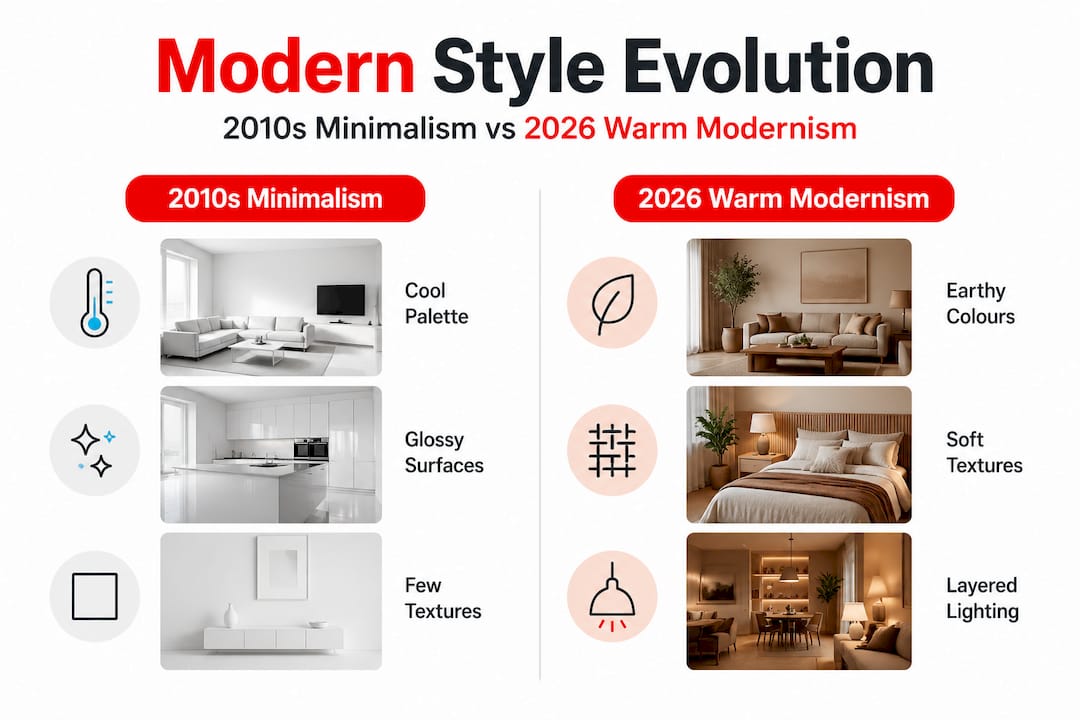
With the basics established, let's see how UK modern homes are updating the look for comfort and warmth. The most significant shift in recent years is the rise of what designers are calling warm minimalism or, in its fullest expression, warm modernism.
In 2026, UK trends show that modern style has evolved to soften the stark minimalism of the previous decade with textures, warmer neutrals, layered lighting, and tactile materials. The result is a home that feels curated and calm rather than empty and cold.
Here's how the shift looks in practice:
| Feature | 2010s minimalism | 2026 warm modernism |
|---|---|---|
| Colour palette | Cool whites, greys, black accents | Creamy whites, earthy tones, warm terracottas |
| Materials | Polished concrete, glass, steel | Timber, bouclé, microcement, linen |
| Lighting | Recessed downlights only | Layered: pendants, floor lamps, wall lights |
| Furniture | Geometric, low-profile, sparse | Curved, tactile, considered but comfortable |
| Feel | Clinical, gallery-like | Warm, lived-in, calm |
The numbers support this shift too. Interior design searches in the UK for "warm minimalism" and "earthy interiors" have grown substantially year on year, reflecting a clear appetite for modern design that doesn't feel punishing to live in.
Pro Tip: The easiest way to add warmth to a modern interior is not to buy more things. It's to swap one or two key surfaces or textiles for something tactile. A bouclé throw, a raw linen cushion, or a natural timber shelf can transform the feel of a room without cluttering it.
Layered lighting deserves particular attention here. Rather than relying on a single overhead light source, the 2026 approach uses three to five light sources per room at different heights. Think a pendant over the dining table, a floor lamp beside the sofa, and discreet under-cabinet lighting in the kitchen. Each layer adds mood without adding clutter.
Smart, sustainable and practical: Core mechanics of modern UK homes
Now that trends are clear, it's crucial to understand the foundational mechanics making this style practical and future-ready. Modern home style in the UK isn't just about appearance. It's built on a set of performance principles that make homes more efficient, comfortable, and resilient.
Space planning is where it starts. Open-plan layouts remain popular, but the "broken plan" approach is gaining ground. This uses low partitions, changes in floor level, or furniture placement to zone a space without closing it off entirely. It's more suited to family life and offers acoustic privacy without sacrificing the sense of openness.
Sustainable materials are now expected rather than exceptional. Responsibly sourced timber, recycled brick, and high-performance insulation are standard in modern UK builds and renovations. These choices reduce environmental impact and improve long-term running costs.
Smart home technology has matured considerably. It's no longer about novelty gadgets but about systems that genuinely reduce energy use, improve comfort, and simplify daily life. Automated blinds, programmable heating, energy monitoring, and connected appliances all contribute.
UK net-zero guidance for modern homes sets clear benchmarks: low form factor, balanced window-to-wall ratios, airtightness below 0.85 air changes per hour, high fabric U-values, and heat pumps to reduce operational carbon significantly. These aren't just targets for new builds. They're increasingly relevant for anyone renovating a UK home with modern principles in mind.
The key sustainable upgrades to prioritise, in order of impact:
- Insulation and airtightness — the single biggest factor in heat loss and energy bills
- Double or triple glazing — particularly important for large window-heavy modern designs
- Heat pump installation — replacing gas boilers reduces operational carbon substantially
- Solar panels — complement heat pumps and reduce dependence on the grid
- Smart controls — optimise energy use without requiring behaviour changes
Pro Tip: When planning any modern home upgrade, start with the building fabric before adding technology. A well-insulated home with a modest boiler will always outperform a poorly insulated home with the latest smart heating system.
Explore practical home solutions that support a more efficient and stylish living environment without requiring a full structural overhaul.
Blending modern style with character: Adapting for UK homes
These mechanics aren't one-size-fits-all, especially in the UK's diverse housing stock — here's how you can adapt them practically. The UK presents a unique design challenge. Millions of homes are Victorian terraces, Edwardian semis, or properties within conservation areas. Achieving a modern feel in these contexts requires sensitivity and creativity.
The good news is that broken plan layouts and hybrid approaches are well-suited to exactly this kind of property. In a narrow terrace where knocking through walls isn't structurally straightforward or planning-approved, you can still create openness through other means.
Key strategies for modernising traditional UK homes:
- Replace internal doors with glass-panelled or open-framed alternatives to borrow light between rooms without structural changes
- Use a consistent material palette across rooms to create a sense of flow even in segmented layouts
- Retain original features such as cornicing or fireplaces as intentional contrast against modern surfaces — this is a design move, not a compromise
- Introduce modern lighting throughout regardless of other constraints; it's one of the highest-impact changes per pound spent
- Update kitchens and bathrooms in a modern idiom even when living areas remain more traditional
"The most admired British interiors often hold a tension between old and new. A Georgian sash window over a sleek marble worktop. Victorian floorboards under a contemporary pendant. The contrast is the point."
Heritage and planning constraints are real. In a conservation area, you may not be able to add a flat roof extension or install floor-to-ceiling glazing on the front elevation. But you can almost always modernise interiors, and the exterior can often be updated through sensitively chosen windows, doors, and landscaping. Working with a planning consultant early saves costly mistakes later.
The hybrid modern-traditional approach is arguably the most interesting and most British of all the design directions available. It draws on the depth and texture of older buildings while adding the efficiency, openness, and clarity of modern design thinking.
Expert guidance: Making your modern home both liveable and personal
Finally, let's translate design theory into concrete steps for creating a space that's unmistakably modern yet unmistakably yours. The risk with any design framework is that it becomes prescriptive. Modern style, applied without thought, can make a home feel like a showroom: beautiful to look at, uncomfortable to live in.
Expert design thinking recommends prioritising texture over colour for depth, layering three to five light sources per room, using Passivhaus-inspired technology, exploring colour drenching to create a sense of height, and keeping function at the centre with curated personal items rather than decoration for its own sake.
Here are the practical steps to get this balance right:
- Start with function. Decide how each room needs to work before making any aesthetic choices. A kitchen that doesn't flow well won't be saved by beautiful finishes.
- Layer your lighting. This is the single most transformative change in most UK homes, and one of the most affordable if done in stages.
- Choose three materials and repeat them. Limiting your material palette creates cohesion without requiring expensive specialist work.
- Introduce texture before colour. A room with tonal, textured surfaces feels rich and interesting. The same room in flat, smooth surfaces feels cold regardless of colour choice.
- Add your personal moments last. A curated selection of meaningful objects, books, or artwork gives a modern home soul without overwhelming it.
Pro Tip: Resist the urge to style every surface. Modern interiors breathe through negative space. Leave some surfaces bare and let them rest. It's not emptiness; it's the architecture doing its job.
The concept of "colour drenching" is worth noting specifically. This means painting walls, ceiling, skirting boards, and even doors in the same tone. In a room with limited natural light or low ceilings, this approach visually stretches the space and gives a quiet, enveloping warmth that feels modern without feeling minimal.
Why the best modern homes put comfort and context first
There's a version of modern home style that circulates endlessly on social media and architecture websites. It features enormous windows overlooking manicured grounds, polished concrete floors running uninterrupted into a double-height kitchen, and furniture that appears untouched by human hands. It is beautiful. It is also largely irrelevant to most British homeowners.
The honest comparison between modern and traditional shows that traditional design offers genuine charm and cosiness, but comes with higher maintenance demands and lower energy efficiency. Modern design delivers functionality and sustainability but can feel stark without deliberate warming elements. Neither is superior. Both are positions on a spectrum.
What we've seen, working in and around British homes, is that the most successful modern interiors are the ones that know their context. A Victorian semi in Leeds is not a new-build in Surrey. The opportunities and constraints are different. The character of the neighbourhood, the height of the ceilings, the width of the staircase — all of these things shape what modern design can and should look like in that specific house.
Copying an international Instagram aesthetic wholesale is almost always a mistake. Those images are produced in specific climates, cultures, and building types. Applying them directly to a 1930s semi produces something that feels awkward and unresolved, like a costume rather than a home.
The real skill in modern British interior design is knowing which principles travel and which ones don't. Clean lines travel. Respect for natural light travels. Quality over quantity travels. But the specific material palette of a Californian modernist home, or the spatial generosity of a Scandinavian new-build, often doesn't survive the journey.
The homes we find most compelling are those where the modern framework serves the people who live there rather than the other way around. That means accepting the original bay window rather than fighting it. It means using the understairs cupboard thoughtfully rather than eliminating it. It means choosing furniture scaled for the actual room, not the room in the catalogue.
Comfort and context aren't compromises. They're the mark of a well-designed modern home.
Enhance your modern home style with curated essentials
Modern home style is built piece by piece — and the right products make all the difference between a space that looks designed and one that simply looks bought. At IW1T, we've brought together a focused range of curated home essentials that sit comfortably within a modern, considered interior.

From practical storage and lighting accessories to décor that adds texture without clutter, every item in our range has been chosen with real homes in mind — not showrooms. As a family-run business based in the UK, we understand that modern living needs to be functional first and beautiful second. Whether you're updating a single room or working through a full renovation, we make it easy to find quality pieces that fit both your style and your budget, delivered with the care and discretion you'd expect.
Frequently asked questions
How is modern home style different from contemporary design?
Modern home style is tied to specific 20th-century design principles emphasising function and simplicity, while contemporary design reflects whatever is trending at a given moment and shifts continuously over time.
Can modern home style work in small UK terraces or flats?
Absolutely. Clever zoning and tactile finishes make modern design well-suited to narrow terraces and compact flats, especially when paired with modular or minimalist furniture that earns its space.
Does modern home style suit homes in conservation areas?
Yes. Broken plan interiors and hybrid exteriors allow modern style to work sensitively within conservation areas, keeping historic character on the outside while introducing contemporary thinking inside.
Is modern home style considered sustainable?
Modern UK homes regularly incorporate sustainable materials and smart systems — including responsibly sourced timber, recycled brick, and energy-efficient insulation — making sustainability a genuine feature of the style rather than an add-on.
What colours and textures define 2026's modern home style?
Warm minimalism in 2026 uses creamy whites, earthy tones, and tactile materials like bouclé, microcement, and natural linen, brought together with layered lighting to create interiors that feel calm and genuinely welcoming.