
Picture this: you're relaxing in your living room on a Sunday afternoon when a neighbour's gaze drifts straight through your window. That low-level discomfort, the feeling of being watched in your own home, quietly chips away at how restful your space can be. British homes are often designed to maximise light and openness, which is wonderful until it comes at the cost of genuine seclusion. The good news is that you don't have to choose between a bright, beautiful home and a private one. This guide walks you through practical, stylish strategies for every room and garden, so you can reclaim your comfort without sacrificing your aesthetic.
Table of Contents
- Assessing your privacy needs and planning your approach
- Layering window treatments for adjustable indoor privacy
- Using furniture, planting, and design to create indoor visual barriers
- Landscaping, hedges, and fencing for garden privacy
- Creative screening: pergolas, sail shades, and portable barriers
- Our perspective: blending privacy with style for true comfort
- Practical next steps to enhance your privacy in style
- Frequently asked questions
Key Takeaways
| Point | Details |
|---|---|
| Layer privacy solutions | Combine sheer window treatments, furniture, and plants to create flexible privacy zones with natural light. |
| Balance gardens legally | Use layered planting, suitable fences, and trellises within legal limits to maintain outdoor privacy without conflict. |
| Opt for flexibility | Choose movable screens, shades, or shelving to adapt your privacy solutions as your needs and seasons change. |
| Prioritise view framing | Focus on filtering and redirecting views instead of full coverage, preserving openness and inviting spaces indoors and out. |
Assessing your privacy needs and planning your approach
Before you buy a single blind or plant a hedge, it pays to understand exactly where your home is exposed and why. Think of this as your privacy audit, a room-by-room, garden-by-garden assessment of where you feel most overlooked or exposed throughout the day.
Start by walking through each room at different times. Morning light changes where sightlines fall compared to afternoon sun. Stand at your sofa, your dining chair, your bed, and consider what someone outside could realistically see. In the garden, walk the perimeter and note which neighbours' windows or elevated positions overlook your seating and entertaining areas.
Key questions for your privacy audit:
- Which rooms feel most exposed and at what time of day?
- Is the exposure coming from street level, elevated positions, or neighbouring gardens?
- Are you seeking visual privacy, acoustic privacy, or both?
- How much natural light do you want to preserve in each area?
- Do any existing structures or mature plants already provide partial cover?
Once you have a clear picture, it's easier to prioritise. Interior privacy problems are often solved quickly with window treatments. Exterior challenges may require a longer-term plan involving planting, fencing, or screening structures.
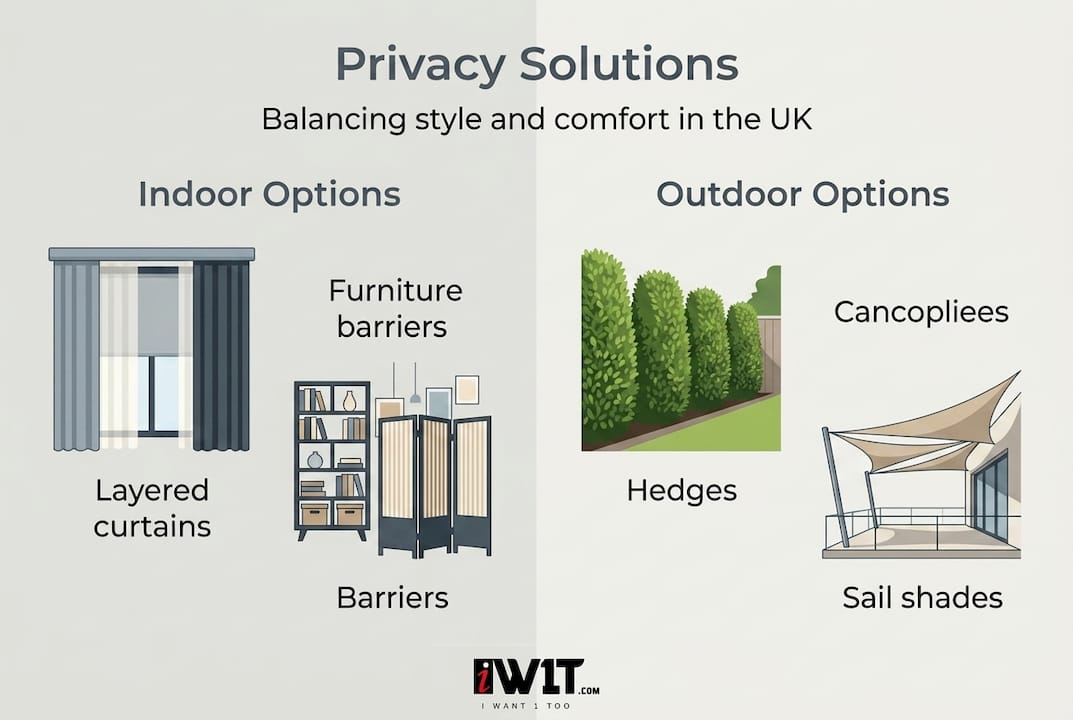
There are also legal and practical matters to consider before making changes, particularly outdoors. Sightline mapping is particularly important in urban and overlooked gardens, as hedges planted near boundaries can cause damage or disputes with neighbours. It's always worth having an honest conversation with your neighbours before installing anything significant. Goodwill goes a long way, and it avoids the stress of disputes later.
| Privacy challenge | Priority level | Typical solution |
|---|---|---|
| Overlooked living room window | High | Sheer voile, tier-on-tier blind |
| Exposed rear garden seating area | High | Fence, trellis with climbers |
| Open-plan interior zones | Medium | Shelving, plants, acoustic panels |
| Side access or passageway | Medium | Fencing, gate, hedge |
| Front garden boundary | Low to medium | Low hedge, decorative fence |
Pro Tip: Photograph your garden and key windows from street level and from any elevated positions nearby. Seeing your home from the outside gives you a far more accurate picture of what's actually visible to others.
Layering window treatments for adjustable indoor privacy
With your main privacy pain points mapped out, start indoors by optimising window treatments for flexibility, light, and visual appeal. Windows are the most immediate source of exposure in most UK homes, and they're also where small changes deliver the biggest daily impact.
The most effective approach is layering. Rather than choosing one solution, combining different treatments lets you adjust privacy levels throughout the day without losing light or style. Layered window treatments using sheer voiles or café curtains paired with heavier curtains or blinds provide adjustable privacy whilst maintaining natural light, which is particularly valuable in the UK where daylight is precious during winter months.
How to layer window treatments step by step:
- Start with a sheer voile or fine-weave net curtain fitted close to the glass. This filters views from outside during daylight hours without darkening the room.
- Add a mid-layer blind, such as a roller or Roman blind in a light fabric. This gives you precise control over privacy in the middle portion of the window.
- Hang a pair of full-length curtains at the outer edge of the window frame. Choose a heavier fabric for evening privacy and light control.
- Consider tier-on-tier shutters if you want a more permanent, tailored look. These are hinged in the middle so you can open the top independently from the bottom, perfect for rooms where you want light from above but coverage at street level.
| Treatment type | Privacy level | Light retention | Cost range | Best suited for |
|---|---|---|---|---|
| Sheer voile | Medium | High | £ | Living rooms, kitchens |
| Roller blind | High | Medium | £ | Bathrooms, bedrooms |
| Tier-on-tier shutters | Very high | High | £££ | Ground floor front rooms |
| Café curtains | Medium | High | £ | Kitchens, bay windows |
| Blackout curtains | Maximum | Low | ££ | Bedrooms |
The goal isn't always total blackout. In fact, one of the most common mistakes UK homeowners make is fitting heavy curtains or frosted glass everywhere, ending up with rooms that feel cave-like and gloomy. The better strategy frames your view rather than eliminating it. Position sheers to cover only the lower third of a window if that's where sightlines fall, leaving the upper portion clear for sky views and natural brightness.
Pro Tip: Hang your curtain pole 15 to 20 centimetres above the window frame and extend it well beyond the frame on each side. This makes windows look larger and allows curtains to stack clear of the glass, maximising light when drawn back.
Using furniture, planting, and design to create indoor visual barriers
While windows are a major source of exposure, how you arrange your interiors adds another layer of everyday privacy. Even with excellent window treatments, a poorly arranged room can leave you feeling exposed simply because of where you sit relative to the glass.
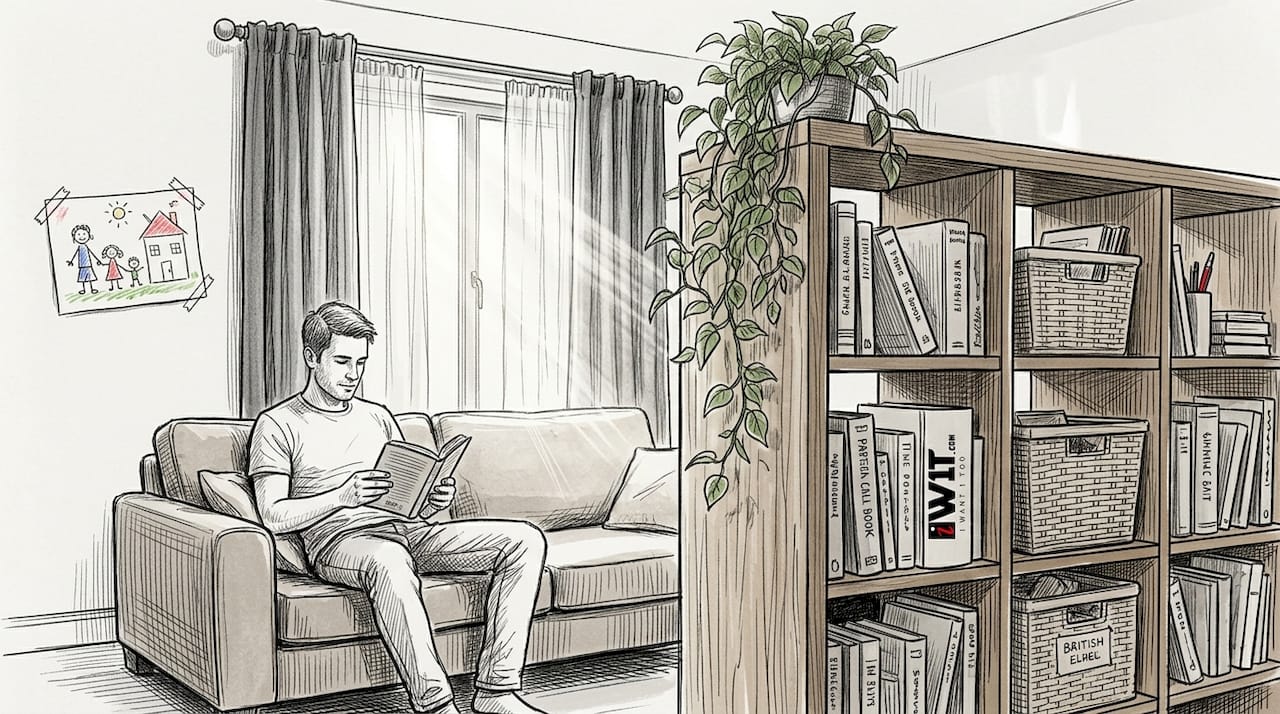
Indoor plants and furniture such as open shelving create effective visual barriers in living spaces without blocking light, whilst acoustic panels and rugs reduce noise in open-plan layouts. This is a particularly useful insight for homes with open-plan kitchen and living areas, where a sense of separation can be hard to achieve without putting up walls.
Practical interior privacy ideas using furniture and plants:
- Place a tall bookcase or open shelving unit perpendicular to a wall to create a room-within-a-room effect. This is especially effective in studio flats or open-plan living spaces.
- Use large-leaved houseplants such as fiddle-leaf figs, monstera, or bird of paradise plants near windows. They soften sightlines and add texture without blocking light significantly.
- Position sofas and armchairs with their backs toward windows where possible. This naturally reduces the visual connection between you and anyone passing outside.
- Layer rugs, heavy curtains, and upholstered furniture to absorb sound. Acoustic privacy is just as important as visual privacy, particularly in terraced houses or flats.
- Use stylish indoor furniture as room dividers. A well-placed console table with a lamp or a sculptural floor plant can define the boundary of a seating zone without the need for a physical partition.
Open-plan spaces are wonderful for socialising but can feel uncomfortably exposed. A floating shelving unit open on both sides, styled with books, plants, and decorative objects, lets light pass through whilst visually screening your seating area from the kitchen or hallway. It also doubles as a display feature, so it earns its place aesthetically as well as practically.
Pro Tip: Tall, narrow plants in woven baskets work brilliantly in corners near windows. They draw the eye upward, add warmth to a room, and create a natural screen that feels intentional rather than defensive.
Landscaping, hedges, and fencing for garden privacy
Decorating for privacy indoors is just the start; extending those principles to your garden opens a new world of options. A well-designed garden can feel like an entirely private outdoor room, even in a densely built-up neighbourhood.
UK back garden fences up to 2 metres high generally require no planning permission, but you should always check with your local authority before installing. Pairing a solid fence with trellises and climbers adds height and a softer, more attractive finish than bare timber or metal alone.
Garden privacy planting and structure ideas:
- Layered planting combines tall trees at the back, medium shrubs in the middle, and low-growing perennials at the front. This creates year-round depth and interest whilst blocking multiple sightline angles.
- Evergreen hedging from species such as yew, laurel, or holly provides permanent screening. However, evergreen hedges over 2m can trigger legal complaints if they begin blocking a neighbour's light, so plant at a safe distance and select species with measured growth rates.
- Climbing plants on trellises such as clematis, wisteria, or star jasmine soften hard fence lines beautifully and add seasonal colour.
- Bamboo in containers is an increasingly popular choice for quick screening along boundaries, and keeping it in large pots prevents the invasive spreading that ground-planted bamboo can cause.
"Layered planting with trees, shrubs and climbers creates privacy without excessive darkness, and hedges should be planted a safe distance from boundaries to avoid disputes."
Hedge law in England and Wales means your neighbour can complain to the council if a hedge exceeds 2 metres and is causing a problem. This doesn't mean avoiding hedges entirely, it means choosing the right species and planning their position thoughtfully. A council can legally require you to cut it back, so getting this right from the start saves a great deal of hassle.
Creative screening: pergolas, sail shades, and portable barriers
For overlooked gardens or patios, flexible and stylish screening solutions can often deliver privacy without major construction. This approach is especially practical for renters, people who aren't ready to commit to permanent changes, or those with small outdoor spaces where large structures would feel oppressive.
Pergolas, sail shades, and freestanding screens shield outdoor seating from view whilst allowing airflow, and clever positioning of seating itself can exploit natural sightlines to your advantage.
How to plan flexible outdoor screening:
- Identify the primary sightline you need to block. Is it a neighbouring upstairs window, a raised terrace, or a public footpath? The direction tells you where to place your screen.
- Choose a sail shade or cantilever parasol for overhead coverage. These block views from above without the permanence or cost of a full pergola.
- Position a freestanding screen or trellis panel on the side most exposed to neighbours. Modular screens can be reconfigured seasonally as your needs change.
- Add a pergola with slatted or louvred roof panels if your space and budget allow. Louvred roofs let you tilt the slats to control both light and the angle of view from above.
- Use large planters with tall grasses or bamboo to create soft, movable screens at key points around a seating area.
| Solution | Privacy level | Permanence | Aesthetics | Approximate cost |
|---|---|---|---|---|
| Sail shade | Medium (overhead) | Semi-permanent | High | £50 to £300 |
| Freestanding screen | High | Portable | Medium to high | £40 to £200 |
| Pergola with louvres | High | Permanent | Very high | £500 to £5,000 |
| Trellis with climbers | Medium to high | Semi-permanent | Very high | £30 to £150 |
| Bamboo in containers | Medium | Portable | High | £20 to £80 per pot |
Pro Tip: When placing a sail shade, angle it so one corner is raised higher than the others. This prevents water pooling after rain and creates a more dynamic, contemporary look rather than a flat, utilitarian cover.
Our perspective: blending privacy with style for true comfort
Here's something worth saying plainly: the obsession with maximum privacy often creates the very problem it's trying to solve. We see it regularly. Homeowners fit heavy shutters, solid fences, and dense hedges on every side, only to find their home feels dark, enclosed, and somehow less comfortable than before. That's what we call the fortress effect, and it's surprisingly common.
The most liveable, comfortable homes we encounter strike a balance. They use filtering rather than total blocking, framing views and layering solutions to create generosity of light alongside genuine privacy. A sheer voile that softens the street view is infinitely more pleasant to live with than a blackout blind pulled permanently shut.
Small, tactical changes consistently outperform drastic ones. Repositioning a sofa, adding a tall plant, swapping a roller blind for a tier-on-tier option: these modest interventions accumulate into a home that genuinely feels private, comfortable, and still beautiful. Privacy doesn't demand sacrifice. It rewards thoughtfulness.
Practical next steps to enhance your privacy in style
Having explored ideas both simple and sophisticated, here's how you can take your home's privacy up a level.

At IW1T, we've curated a range of home décor and lifestyle products designed with comfort, privacy, and everyday practicality in mind. Whether you're looking for tools to help with a weekend DIY project, accessories to dress your windows beautifully, or practical items to make your garden feel like a true retreat, we've got options that won't break the budget. Browse our full range of IW1T privacy solutions and discover how affordable, thoughtful choices can genuinely transform the way your home feels, inside and out. Delivered in discreet packaging, because your business is your own.
Frequently asked questions
Do I need planning permission to build a privacy fence in my UK garden?
Most back garden fences up to 2 metres high require no planning permission, but always confirm with your local authority first, as conservation areas and listed buildings may have different rules.
What's the best way to keep privacy without blocking light?
Layered window treatments such as pairing sheer voiles with thicker curtains give you adjustable control so you can maintain natural light during the day while gaining full privacy in the evenings.
Are there privacy plants suitable for small UK gardens?
Yes, slow-growing evergreens like yew or compact laurel varieties work well, as do climbing plants on trellises; just ensure hedges are planted well back from boundaries to avoid disputes with neighbours.
Can I use furniture and plants to separate open-plan spaces for privacy?
Absolutely. Open shelving and large potted plants define zones effectively whilst keeping light flowing, and adding rugs or acoustic panels also reduces sound travel between areas.